
Zcash (ZEC) is back in the cryptocurrency spotlight after a powerful recent move.
The market snapshot supplied for this report shows ZEC up approximately 29.9% over seven days, putting Zcash among the stronger-performing major privacy-focused crypto assets during the latest market rotation.
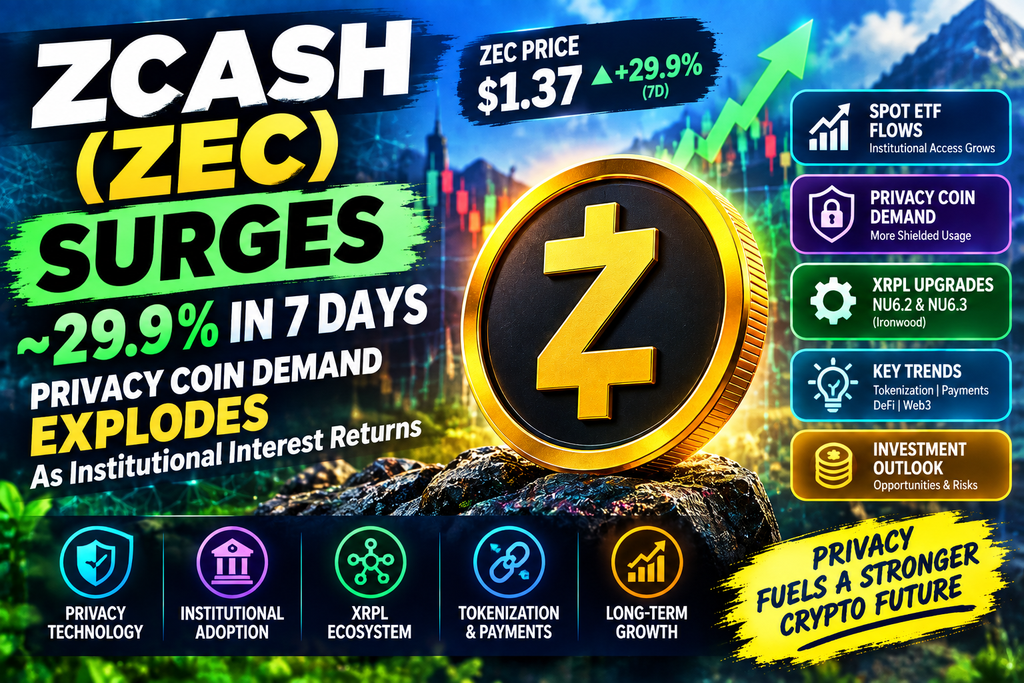
Zcash is benefiting from renewed attention toward financial privacy, shielded transactions, institutional access and zero-knowledge technology, while a new regulated spot investment vehicle has expanded the ways traditional investors can obtain ZEC exposure.
A recent market report says Zcash reached its highest price since 2016 and identifies three major factors behind the renewed interest: the launch of a spot Zcash investment product, a changed regulatory backdrop and increased use of Zcash’s privacy features.
ZEC Rally: Why Is Zcash Outperforming?
The recent ZEC move cannot be explained by one factor.
Several narratives have converged:
🔐 Renewed privacy demand
Privacy has returned as a major theme across cryptocurrency markets.
🏦 Institutional access
A spot Zcash exchange-traded product began trading in the United States in August 2026.
🛡️ Shielded adoption
More ZEC is being held in shielded pools, increasing attention toward the actual use of Zcash’s privacy technology.
🧪 Protocol development
Zcash developers are continuing work on security, privacy and future network upgrades.
📈 Crypto-market rotation
When capital rotates into smaller or more specialized crypto sectors, privacy-focused assets can experience much larger percentage moves because their liquidity is generally lower than that of Bitcoin and other mega-cap assets.
This combination can create powerful rallies—but also substantially higher volatility.
Zcash Spot Investment Product: A Major Institutional Catalyst
One of the most important developments for Zcash in 2026 is the arrival of a U.S.-listed spot investment product.
According to recent reporting, Grayscale’s ZCSH product began trading on NYSE Arca on August 25, 2026. The product gives investors access to spot Zcash exposure through a traditional brokerage structure.
The same report says assets under management passed $500 million within approximately two weeks of launch.
That is significant because traditional investors can gain exposure without necessarily having to:
- create a crypto wallet;
- manage private keys;
- use a crypto exchange;
- interact directly with the Zcash network.
Why this matters for ZEC
Institutional investment products can potentially broaden the addressable investor base.
But investors should separate:
ETF/product availability
from
persistent net capital inflows.
The second is the more important metric for determining whether institutional demand is becoming durable.
The ZCSH Effect: What Investors Should Monitor
Readers following Zcash should keep an eye on:
- daily creations/redemptions;
- assets under management;
- trading volume;
- premium/discount behavior where applicable;
- institutional ownership;
- long-term inflow trends.
A strong launch can attract attention, but the market ultimately needs to determine whether that demand persists.
Why Privacy Coins Are Trending Again
The broader privacy narrative is arguably the most important part of the current Zcash story.
Blockchain transactions are generally transparent.
That transparency can be useful for auditability and verification, but it also means transaction history can potentially reveal sensitive financial information.
Zcash takes a different approach.
It uses zero-knowledge cryptography to allow shielded transactions in which transaction information can be protected while still proving that the transaction follows the protocol’s rules.
Zcash also has an optional privacy model: users can use transparent transactions or shielded transactions.
This creates a distinctive proposition:
Public blockchain infrastructure with an option for stronger financial privacy.
Shielded ZEC Adoption Is an Important Metric
One of the most closely watched Zcash metrics is the amount of supply held in shielded pools.
Recent reporting says more than 30% of total ZEC supply is now shielded, indicating that privacy functionality is being used rather than remaining purely theoretical.
That statistic deserves attention because the long-term Zcash investment thesis depends partly on whether people actually want the privacy functionality.
If shielded usage continues growing, it provides evidence that privacy is becoming a more important feature for users.
However, investors should also watch:
- shielded transaction volume;
- active shielded addresses;
- wallet adoption;
- merchant/payment usage;
- developer activity.
Supply sitting in shielded pools alone doesn’t tell the entire story.
Zcash’s Biggest Technology Advantage: Zero-Knowledge Privacy
Zcash is one of the longest-running large-scale implementations of privacy-focused blockchain technology.
Its design uses zero-knowledge proofs to allow network participants to verify transaction validity without necessarily exposing transaction details.
This technology is important beyond Zcash itself.
Zero-knowledge proofs have become an increasingly important technology across the wider cryptocurrency industry, including scaling and privacy applications.
That gives Zcash an interesting position:
It is both a privacy-focused cryptocurrency and part of the longer history of practical zero-knowledge blockchain technology.
Zcash Security Shock: The 2026 Orchard Vulnerability
The current rally needs to be viewed alongside one of the biggest risks Zcash faced this year.
In June 2026, developers disclosed a serious vulnerability affecting the Orchard shielded pool.
The issue triggered a major market reaction, with ZEC experiencing a sharp decline during the initial disclosure period. Contemporary reporting described a decline of roughly 50% during the episode.
This is important for investors because privacy technology is inherently dependent on cryptographic security.
A vulnerability affecting a shielded pool can potentially undermine confidence in the very feature that differentiates Zcash from ordinary transparent blockchains.
NU6.2: Zcash’s Emergency Security Response
Zcash subsequently implemented a major security response.
The Zcash protocol documentation identifies NU6.2 as the most recent settled mainnet network upgrade, activated at block height 3,364,600 on June 3, 2026.
The documentation describes NU6.2 as including the Orchard temporary vulnerability mitigation.
This is an important part of the current Zcash story.
The market is therefore evaluating both:
the vulnerability
and
the development team’s response to it.
A protocol’s ability to identify, contain and remediate serious security problems is an important consideration for long-term users and investors.
What Comes After NU6.2?
The Zcash development roadmap continues beyond the emergency security response.
The official ZIP documentation currently identifies NU6.3 candidate ZIPs, including:
- ZIP 229 — Version 6 Transaction Format;
- ZIP 2005 — Ironwood Quantum Recoverability;
- ZIP 2006 — restrictions concerning transfers to the Orchard pool;
- ZIP 318 — Orchard-to-Ironwood migration;
- ZIP 326 — NU6.3 consequences for wallets;
- ZIP 209 — out-of-range chain-value-pool balance protections.
These proposals are particularly important because they show that the Zcash development story is moving toward another stage of privacy and security infrastructure.
Ironwood: The Next Zcash Technology Story
Ironwood is one of the most important names for Zcash investors to watch.
The proposed architecture is connected to the network’s longer-term privacy and security roadmap.
One particularly interesting area is quantum recoverability.
The Zcash ZIP repository identifies ZIP 2005 as Ironwood Quantum Recoverability, indicating that developers are considering how Zcash’s cryptographic infrastructure can respond to future advances in computing technology.
This is not a claim that quantum computers currently threaten Zcash.
Instead, it demonstrates that developers are considering long-term cryptographic resilience.
Zcash and the Quantum-Resistance Narrative
Quantum computing is still a developing technology, but the possibility of sufficiently powerful quantum computers has become an important subject across cryptography.
Zcash’s roadmap has placed post-quantum considerations directly into its development discussions.
Recent reporting says the Zcash Open Development Lab has been targeting a move toward stronger post-quantum security over a roughly 12-to-18-month development horizon from May 2026.
For investors, this is a long-term technology story—not a short-term price catalyst.
The important metrics will be:
research → implementation → testing → audit → deployment.
Zcash’s 21 Million Supply Cap
Another part of Zcash’s investment thesis is its limited supply.
Zcash shares a 21 million maximum supply characteristic with Bitcoin and uses proof-of-work consensus.
Limited supply does not automatically create price appreciation.
Demand still matters.
The investment equation is therefore better understood as:
Limited supply + increasing demand = potential price pressure
while:
Limited supply + weak demand = no guaranteed appreciation.
This distinction is especially important after a rapid 29.9% weekly rally.
Why ZEC Can Move So Quickly
Zcash’s market capitalization and liquidity are considerably smaller than Bitcoin’s.
That means relatively modest changes in capital flows can produce larger percentage price movements.
During periods of strong momentum, this can create:
- rapid breakouts;
- short squeezes;
- increased leverage;
- FOMO;
- sharp pullbacks.
The same characteristic that creates large upside moves can therefore create equally large downside moves.
Investors should not confuse volatility with certainty.
Is the Current ZEC Rally Fundamentals or FOMO?
This is one of the most important questions for readers.
The answer may ultimately involve both.
Fundamental factors
- spot investment-product access;
- growing shielded usage;
- privacy demand;
- protocol development;
- security improvements;
- future cryptographic upgrades.
Momentum factors
- rapid price appreciation;
- social-media attention;
- trader positioning;
- short covering;
- speculative capital rotation.
The best way to distinguish them is to watch whether on-chain adoption and institutional demand continue after the initial price surge.
Zcash vs. Monero: The Privacy Coin Competition
Zcash is not alone in the privacy-coin market.
Monero (XMR) remains one of the most important privacy-focused competitors.
The two projects use different privacy designs.
Zcash provides optional shielded transactions, while Monero has a privacy model built much more deeply into its standard transaction architecture.
This creates different trade-offs concerning:
- privacy defaults;
- transparency;
- compliance;
- usability;
- exchange availability;
- ecosystem development.
For Zcash investors, competition from Monero and other privacy technologies remains an important risk factor.
Zcash Investment Outlook: Three Possible Scenarios
Instead of publishing an unrealistic guaranteed ZEC price target, investors can consider three broad scenarios.
Scenario 1: Privacy demand continues accelerating
Potential developments:
- more institutional ZEC exposure;
- persistent spot-product inflows;
- higher shielded adoption;
- continued wallet growth;
- stronger privacy-technology demand;
- successful network upgrades.
Under this scenario, Zcash could receive continued attention from both institutional and crypto-native investors.
This is a scenario—not a price prediction.
Scenario 2: The market consolidates
ZEC could enter a consolidation phase if:
- the initial institutional excitement cools;
- traders take profits;
- privacy-coin demand stabilizes;
- broader crypto markets move sideways.
This would allow investors to evaluate whether the recent rally is supported by lasting adoption.
Scenario 3: Momentum reverses
ZEC could experience a significant correction if:
- institutional flows weaken;
- liquidity falls;
- traders unwind leveraged positions;
- privacy-coin regulation becomes more restrictive;
- another security concern emerges;
- broader crypto markets sell off.
Given ZEC’s volatility, this scenario deserves serious consideration.
The Biggest Regulatory Risk for Zcash
Privacy coins face a unique regulatory challenge.
Financial privacy can be useful for legitimate users, but regulators and exchanges may impose additional compliance requirements on privacy-enhancing technologies.
Potential consequences include:
- exchange restrictions;
- reduced liquidity;
- delistings;
- additional compliance requirements;
- institutional hesitation.
Recent analysis of Zcash specifically identifies regulatory pressure and exchange availability as important risks for the asset.
This is one of the major differences between ZEC and more broadly adopted cryptocurrencies such as Bitcoin.
Zcash Investment Planning: What Should Investors Watch?
A Practical ZEC Investment-Planning Framework
Investors considering ZEC exposure can use a staged approach rather than trying to predict one perfect entry.
Step 1 — Establish a risk budget
Decide beforehand how much capital can be allocated to a high-volatility cryptocurrency.
Step 2 — Avoid chasing a vertical move
A nearly 30% weekly increase can create significant momentum—but it can also increase the risk of profit-taking.
Step 3 — Watch confirmation
Look for continued:
- spot demand;
- institutional flows;
- shielded adoption;
- network activity.
Step 4 — Define invalidation conditions
Ask what would cause the original thesis to change.
Examples could include:
- persistent institutional outflows;
- falling shielded adoption;
- major security failures;
- worsening exchange access;
- unfavorable regulatory changes.
Step 5 — Keep leverage limited
Rapidly moving privacy coins can produce large liquidation events.
Position sizing can therefore matter more than attempting to predict every short-term move.
What Could Drive ZEC Higher?
Several potential catalysts could support continued market attention.
🔐 Privacy becomes a mainstream crypto narrative
If users increasingly value financial privacy, Zcash could benefit from renewed attention.
🏦 Institutional access expands
The arrival of a U.S.-listed spot Zcash product creates a new distribution channel.
📈 Shielded usage increases
More ZEC moving into shielded pools would provide additional evidence of actual privacy adoption.
🛡️ Security improvements succeed
Successful implementation of NU6.2 and future upgrades could help restore confidence following the Orchard incident.
⚙️ Ironwood progresses
Advances toward the next-generation privacy and cryptographic architecture could strengthen Zcash’s technology narrative.
🌐 Privacy technology expands beyond Zcash
Broader adoption of zero-knowledge technology could increase interest in the sector.
What Could Push ZEC Lower?
The risks are equally important.
Regulatory restrictions
Privacy coins can face additional scrutiny.
Exchange delistings
Reduced exchange availability could reduce liquidity.
Security vulnerabilities
The 2026 Orchard incident demonstrates how quickly cryptographic issues can affect market confidence.
Profit-taking
After a rapid rally, early holders may realize gains.
Competition
Monero and newer privacy protocols compete for users and developers.
Macro conditions
A broader crypto selloff can overwhelm project-specific fundamentals.
Zcash vs. Bitcoin
Zcash and Bitcoin share the 21 million supply concept, but their purposes differ.
| Feature | Zcash | Bitcoin |
|---|---|---|
| Maximum supply | 21 million | 21 million |
| Consensus | Proof of work | Proof of work |
| Privacy | Optional shielded transactions | Primarily transparent |
| Main narrative | Financial privacy | Digital monetary asset |
| Shielded transactions | Yes | No native equivalent |
| Privacy technology | Zero-knowledge proofs | Transparent ledger architecture |
| Major risk | Regulation + security + liquidity | Macro + market volatility |
| Key investment question | Will privacy demand grow? | Will monetary/store-of-value demand grow? |
The comparison highlights why ZEC should not simply be treated as “another Bitcoin.”
Final Zcash Takeaway
Zcash is experiencing a major resurgence in market attention.
The reported ~29.9% seven-day gain is only the most visible part of the story.
Behind the price move are several important developments:
🔐 Renewed demand for financial privacy
🏦 New institutional access through ZCSH
📊 Growing shielded ZEC adoption
🛡️ The NU6.2 security response
⚙️ The developing NU6.3/Ironwood roadmap
🌐 Broader interest in zero-knowledge technology
The strongest long-term signal would be continued growth in actual privacy usage and institutional demand after the initial price excitement fades.
For investors, the key question isn’t simply:
“How high can ZEC go?”
A better question is:
“Is Zcash’s privacy utility growing faster than the risks associated with regulation, security, liquidity and competition?”
That is the question readers should continue revisiting as new market and network data arrive.
Frequently Asked Questions About Zcash
Why is Zcash (ZEC) trending?
ZEC is benefiting from a combination of renewed privacy-coin interest, strong recent price performance, increased shielded usage and new institutional investment access.
What is Zcash?
Zcash is a privacy-focused cryptocurrency launched in 2016. It uses zero-knowledge cryptography and allows users to make either transparent or shielded transactions.
What is the maximum supply of Zcash?
Zcash has a maximum supply of 21 million ZEC.
What happened to Zcash in June 2026?
A serious vulnerability affecting the Orchard shielded pool was disclosed, resulting in a major market selloff and an emergency protocol response. NU6.2 subsequently activated on June 3, 2026.
What is Ironwood?
Ironwood is part of the developing Zcash roadmap, with proposed work including quantum recoverability and migration from the Orchard shielded pool.
Does Zcash have institutional investment access?
Yes. A U.S.-listed spot Zcash investment product under the ZCSH ticker began trading on August 25, 2026, according to recent reporting.
Is Zcash a low-risk cryptocurrency?
No. ZEC remains a high-volatility cryptocurrency. Its risks include regulatory restrictions, exchange access, liquidity, competition and protocol-security issues.
Risk Disclaimer
This article is intended for news, research and educational purposes only and does not constitute personalized financial advice or a recommendation to buy or sell ZEC. Cryptocurrency prices can move sharply in either direction, and investors can lose substantial or all of their capital. Always verify live market prices, investment-product flows, regulatory developments and tax requirements before making an investment decision.
Published/Updated: September 20, 2026