
Solana News Today: Why SOL Is Back on Investors’ Radar
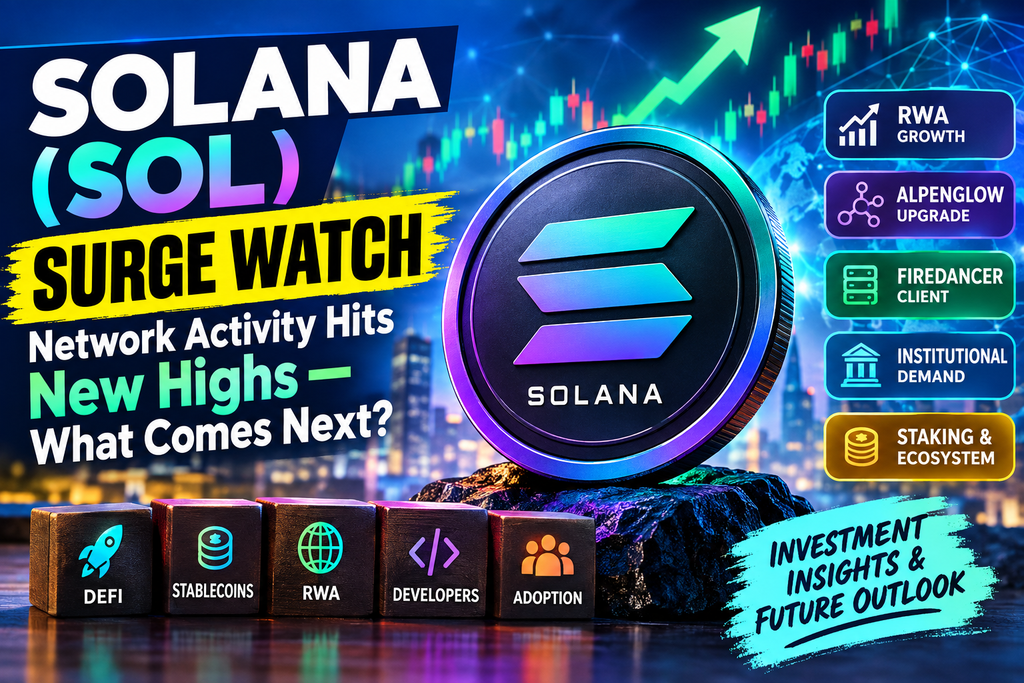
Solana (SOL) is once again attracting significant attention across the cryptocurrency market as network activity, real-world-asset adoption and expectations surrounding major protocol upgrades provide fresh catalysts for the blockchain.
Recent market coverage indicates that Solana has been showing stronger underlying network activity even while its token price remains sensitive to broader crypto-market conditions. One recent report highlighted SOL breaking above a long-term descending trendline while Solana network activity reached a new high.
Another recent analysis reported that Solana has attracted nearly $400 million in real-world-asset net inflows over the previous 30 days, putting the blockchain among the networks attracting significant RWA activity.
For investors, the important question is therefore not simply whether SOL goes up or down next. The bigger question is whether Solana’s underlying ecosystem continues expanding enough to support sustained demand for the network and its native token.
What Is Driving Solana Right Now?
Several developments are contributing to the renewed focus on SOL.
1. Solana Network Activity Is Increasing
One of the most important indicators to watch is activity on the blockchain itself.
Recent reporting points to Solana network activity reaching an all-time high while SOL also moved above a long-term descending trendline.
That combination matters because cryptocurrency valuations can become more sustainable when token demand is accompanied by actual network usage.
However, investors should distinguish between:
- transaction activity,
- economic activity,
- speculative trading,
- stablecoin transfers,
- DeFi volume,
- genuine application usage.
A high transaction count by itself does not automatically mean SOL’s value must rise.
Solana and the Real-World Asset Trend
Real-world assets, or RWAs, have become one of the most closely watched areas of blockchain development.
Tokenization allows assets or financial claims associated with traditional markets to be represented on blockchain infrastructure.
Recent Solana reporting indicates nearly $400 million of RWA net inflows over a 30-day period, highlighting the growing role of the network in this sector.
This could become an important long-term theme because blockchain adoption is increasingly moving beyond purely speculative crypto applications.
Why RWA adoption matters for SOL
If more financial applications use Solana infrastructure, potential benefits could include:
- greater blockchain transaction activity;
- additional stablecoin usage;
- increased developer activity;
- greater institutional visibility;
- deeper liquidity;
- additional demand for Solana-based applications.
The key risk is that growing activity in the Solana ecosystem does not necessarily translate one-for-one into SOL price appreciation.
Investors should therefore track economic value captured by the network, rather than simply counting announcements.
Alpenglow: One of Solana’s Biggest Upcoming Technology Catalysts
One of the major developments investors are watching is Alpenglow, Solana’s proposed next-generation consensus architecture.
The upgrade is designed to significantly improve the network’s confirmation and finality characteristics.
Recent 2026 coverage describes Alpenglow as one of the major architectural changes on Solana’s roadmap.
If successfully implemented and adopted, improvements to finality and network performance could make Solana increasingly attractive for applications requiring fast settlement.
Potential beneficiaries could include:
- decentralized exchanges;
- payments;
- stablecoins;
- tokenized assets;
- gaming;
- financial applications;
- high-frequency on-chain applications.
But an important distinction remains: a planned or developing upgrade is not the same thing as a completed upgrade operating at full scale.
Investors should therefore monitor official Solana development updates and implementation milestones rather than valuing SOL solely on future promises.
Firedancer Remains Another Major Solana Catalyst
Firedancer is another major technology development associated with Solana.
The project is intended to provide an additional high-performance validator client and strengthen the network’s resilience and performance.
Why does this matter?
Blockchain infrastructure benefits from client diversity because reliance on a single implementation can create additional operational and systemic risks.
A successful Firedancer rollout could potentially contribute to:
- greater validator diversity;
- network resilience;
- higher performance;
- improved infrastructure confidence;
- broader institutional interest.
Some 2026 market analyses have highlighted Firedancer alongside Alpenglow as major factors investors are watching for Solana’s future development.
Again, investors should evaluate actual implementation progress rather than treating projected technical specifications as guaranteed future performance.
Solana Institutional Adoption: Another Trend to Watch
Institutional participation has become an increasingly important theme throughout the digital-asset market.
Solana’s growing presence in institutional discussions is significant because traditional financial institutions generally require:
- reliable infrastructure;
- deep liquidity;
- regulatory clarity;
- predictable settlement;
- institutional custody;
- mature market infrastructure.
The broader institutionalization of crypto and DeFi is also being studied by organizations such as the OECD, which has examined increasing institutional participation and the links between decentralized finance and traditional financial markets.
For SOL investors, institutional adoption should therefore be monitored through measurable indicators such as:
- investment-product flows;
- institutional custody activity;
- tokenized-asset launches;
- stablecoin growth;
- developer activity;
- on-chain liquidity;
- institutional partnerships.
Solana ETF Interest: Why Investors Are Watching Flows
Exchange-traded products connected to crypto assets can potentially make digital assets easier for traditional investors to access.
That makes institutional product flows an important metric for SOL watchers.
However, investors should avoid interpreting every ETF-related headline as an automatic bullish signal.
The more useful questions are:
Are inflows persistent?
Are assets under management growing?
Are institutional investors holding exposure for longer periods?
Are flows occurring alongside stronger network fundamentals?
Combining these indicators provides a more useful picture than focusing on a single day’s inflow or outflow.
SOL Price Outlook: What Should Investors Watch?
Rather than relying on a single price prediction, investors can construct several possible scenarios.
Scenario 1: Network-growth scenario
This scenario would involve:
- increasing Solana transaction activity;
- continued RWA adoption;
- growing stablecoin liquidity;
- successful major network upgrades;
- stronger institutional participation;
- improving overall crypto-market conditions.
If these factors develop together, market participants could potentially place a higher valuation on Solana’s ecosystem.
This is a scenario, not a forecast.
Scenario 2: Consolidation scenario
SOL could also remain volatile or range-bound if:
- crypto liquidity remains limited;
- network growth does not translate into sustained economic activity;
- institutional flows slow;
- investors rotate toward Bitcoin or other assets;
- macroeconomic conditions remain unfavorable.
Under this scenario, fundamental development could continue without producing immediate token-price gains.
Scenario 3: Risk-off scenario
A broader cryptocurrency selloff could put substantial pressure on SOL even if Solana’s technology continues developing.
Potential triggers include:
- falling crypto liquidity;
- large Bitcoin drawdowns;
- worsening macroeconomic conditions;
- regulatory uncertainty;
- leveraged liquidations;
- declining DeFi activity;
- loss of speculative interest.
This is particularly important because SOL remains a high-volatility crypto asset.
Solana Investment Planning: A Practical Framework
For readers considering SOL exposure, a disciplined framework can be more useful than trying to identify the exact market bottom or top.
1. Avoid putting the entire planned allocation into one entry
Instead of assuming that one purchase price will be perfect, investors may consider dividing a predetermined allocation into multiple entries.
For example:
Entry A: Initial position
Entry B: Additional allocation after a significant pullback or confirmation
Entry C: Additional allocation after fundamental or technical confirmation
This approach can reduce dependence on successfully timing a single price.
2. Track Bitcoin Before Making a SOL Decision
SOL does not trade in isolation.
The broader crypto market, particularly Bitcoin’s direction and liquidity conditions, can have a significant influence on large-cap altcoins.
A strong Solana-specific story can therefore still experience price pressure if the overall crypto market enters a risk-off period.
3. Watch Solana Stablecoin Liquidity
Stablecoin supply and transaction activity can provide useful information about capital moving through an ecosystem.
Increasing stablecoin liquidity can support:
- DeFi;
- trading;
- payments;
- lending;
- decentralized exchanges;
- tokenized assets.
But again, stablecoin growth should be evaluated alongside actual economic activity.
4. Monitor Total Value Locked and DeFi Volumes
Investors should regularly examine:
- Solana TVL;
- decentralized-exchange volume;
- lending activity;
- stablecoin supply;
- active addresses;
- fees;
- applications generating revenue.
These metrics help distinguish genuine ecosystem expansion from temporary speculative activity.
SOL Staking: Another Factor for Long-Term Holders
SOL holders can also participate in network staking.
Staking can potentially generate additional SOL rewards while contributing to network security.
However, staking should not be treated as risk-free income.
Investors need to consider:
- SOL price volatility;
- validator performance;
- staking mechanics;
- liquidity requirements;
- opportunity cost;
- tax treatment in their jurisdiction.
A staking yield does not protect an investor from a decline in the underlying SOL price.
Biggest Risks Facing Solana Investors
Solana has significant development activity, but investors should also understand the downside risks.
Market volatility
SOL can experience substantial price movements during both crypto rallies and selloffs.
Competition
Solana competes with other smart-contract platforms for:
- developers;
- users;
- stablecoins;
- liquidity;
- DeFi applications;
- institutional adoption.
Technology risk
Major upgrades can create implementation, migration or operational risks.
Regulatory risk
Changes in digital-asset regulations can affect exchanges, investment products, institutions and token markets.
Speculative activity
High-profile applications and tokens can generate enormous short-term activity that may not translate into durable economic value.
Macro risk
Interest rates, global liquidity, equity-market conditions and investor risk appetite can all influence cryptocurrency valuations.
Solana vs. Ethereum: What Investors Should Compare
Rather than asking which blockchain will “win,” investors can compare the networks according to measurable characteristics.
| Metric | Solana | Ethereum |
|---|---|---|
| Transaction architecture | High-throughput monolithic design | Modular ecosystem |
| Fees | Generally designed for low-cost transactions | Can vary considerably by network conditions and layer |
| DeFi | Large and growing ecosystem | Largest established DeFi ecosystem |
| Stablecoins | Significant and expanding | Extremely significant |
| RWA development | Growing rapidly | Major tokenization ecosystem |
| Institutional interest | Increasing | Very established |
| Scaling strategy | Primarily optimized base layer | Strong Layer-2 ecosystem |
| Main investment question | Can growth continue at scale? | Can Ethereum maintain ecosystem dominance while scaling? |
The comparison illustrates why investors should focus on measurable network fundamentals instead of relying entirely on social-media narratives.
Solana’s Key Catalysts for the Rest of 2026
Investors following SOL should keep a watchlist containing these developments:
🔥 Alpenglow implementation
Watch for development milestones, testing and mainnet progress.
⚡ Firedancer adoption
Validator-client diversity and real-world performance will be important.
🏦 Institutional products
Track institutional flows rather than simply headlines about potential products.
🌎 Real-world assets
Continue monitoring tokenized assets and RWA capital entering Solana.
💵 Stablecoin growth
Increasing stablecoin liquidity could support payments and DeFi.
📊 DeFi activity
TVL, DEX volume, fees and application revenue can reveal whether ecosystem activity is durable.
👨💻 Developer activity
Long-term blockchain value is strongly connected to developers building useful applications.
What Could Make SOL More Attractive to Investors?
A combination of developments would provide stronger fundamental evidence than any single headline.
Investors could watch for:
Network activity ↑
Stablecoin liquidity ↑
RWA adoption ↑
DeFi activity ↑
Developer activity ↑
Institutional participation ↑
Protocol reliability ↑
When several of these indicators improve simultaneously, the fundamental Solana story becomes more significant.
What Could Invalidate the Bullish Thesis?
A disciplined investor should also define what would change their thesis.
Warning signs could include:
- sustained decline in network usage;
- weakening developer activity;
- falling DeFi liquidity;
- declining stablecoin activity;
- major technical problems;
- failed or delayed upgrades;
- sustained institutional outflows;
- deteriorating crypto-market liquidity.
This approach helps investors avoid becoming emotionally attached to a cryptocurrency narrative.
Solana Investment Strategy: What Should Investors Do Now?
There is no single strategy that fits every SOL investor.
A long-term investor may focus primarily on:
network adoption + technology development + institutional participation + ecosystem revenue.
A shorter-term trader may focus more heavily on:
price structure + volume + liquidity + Bitcoin correlation + market momentum.
A staking-focused holder may prioritize:
validator reliability + staking mechanics + long-term SOL exposure.
The important point is to establish the time horizon and risk tolerance before entering a position.
Final Takeaway: Why Solana Is Trending Again
Solana is entering another important phase of its development.
The current story is broader than simply SOL’s daily price.
Recent reporting points to strong network activity and significant RWA inflows, while major technology developments including Alpenglow and Firedancer remain important parts of the Solana roadmap.
For investors, the most important indicators to follow through the remainder of 2026 are likely to be:
1. Solana network usage
2. RWA adoption
3. Stablecoin liquidity
4. DeFi volumes and TVL
5. Alpenglow progress
6. Firedancer deployment
7. Institutional investment flows
8. Overall Bitcoin and crypto-market liquidity
The strongest investment research is not about finding one sensational SOL price target. It is about determining whether Solana’s actual usage, economic activity and institutional adoption are continuing to improve.
Investor Risk Reminder
SOL is a highly volatile cryptocurrency. The scenarios discussed above are analytical frameworks rather than guaranteed outcomes or personalized financial advice. Investors should consider their own risk tolerance, investment horizon, liquidity needs and local tax/regulatory rules before making any cryptocurrency decision.
Frequently Asked Questions About Solana
Is Solana still relevant in 2026?
Yes. Recent market coverage continues to highlight Solana’s network activity, RWA adoption and upcoming technological developments as important themes in the blockchain sector.
What is the biggest Solana upgrade to watch?
Alpenglow is one of the most important developments on the current Solana roadmap, while Firedancer is another major infrastructure development to monitor.
Is Solana a risk-free investment?
No. SOL remains a highly volatile crypto asset and can decline substantially during broader market downturns.
What should investors monitor besides the SOL price?
Network activity, stablecoin liquidity, DeFi TVL, DEX volume, fees, developer activity, RWA adoption, institutional flows and protocol upgrades can provide a broader picture of Solana’s health.
Can Solana reach a specific future price?
No future SOL price can be known with certainty. Investors should use multiple scenarios and monitor fundamental and market data instead of relying on a single price target.