
Ethereum Latest News: Why ETH Is Back in the Spotlight
Ethereum (ETH) is once again one of the most closely watched cryptocurrencies as the market weighs a combination of institutional demand, ETF flows, network adoption, staking growth, DeFi activity and the next generation of Ethereum upgrades.
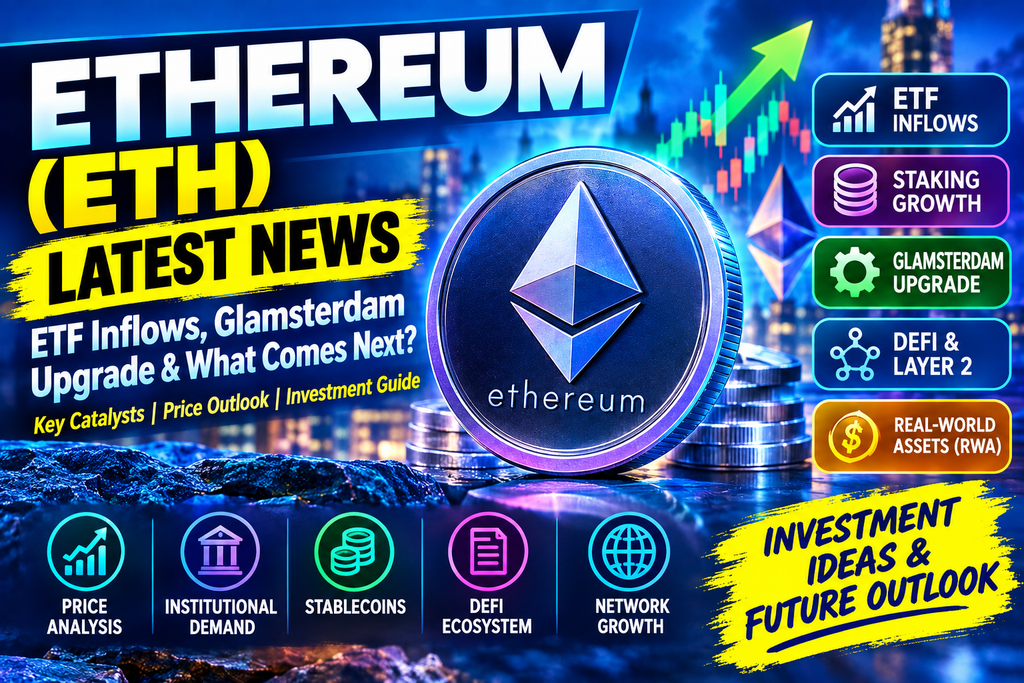
As of September 20, 2026, Ethereum was trading around $2,580, while Indian-market data put ETH around ₹2.47 lakh. ETH had climbed substantially during the middle of September before giving back some gains in the latest session.
The recent price action is particularly interesting because Ethereum’s story is no longer simply about cryptocurrency speculation.
Ethereum is increasingly being evaluated as infrastructure for:
- decentralized finance;
- stablecoins;
- tokenized real-world assets;
- institutional settlement;
- Layer-2 networks;
- staking;
- decentralized applications;
- digital assets and financial infrastructure.
That makes the next phase of Ethereum particularly important for long-term investors.
ETH Price Today: Ethereum Pulls Back After September Rally
Ethereum has experienced a significant change in momentum during September.
According to recent Indian-market data, ETH closed around ₹2.53 lakh on September 19, after rising approximately 7% over the previous session, before falling back toward ₹2.47 lakh on September 20.
U.S.-dollar market data similarly places ETH around $2,580–$2,630, depending on the exchange and measurement time.
This is important because the market is currently testing whether the September rally represents the beginning of a longer trend or simply a short-term recovery.
Recent technical analysis identified the $2,542 area as an important reference level, with approximately $2,672 being watched as a resistance zone. These are market-analysis levels rather than guaranteed support or targets.
Why ETH’s next move matters
If Ethereum can maintain higher levels after the recent rally, investors may pay greater attention to:
- trading volume;
- ETF flows;
- whale activity;
- ETH staking;
- DeFi liquidity;
- stablecoin supply;
- network activity.
If ETH instead loses important technical levels while ETF flows and broader crypto liquidity weaken, the market could enter another period of consolidation.
Ethereum ETF Demand Is Becoming a Major ETH Story
One of the biggest developments surrounding Ethereum in 2026 is the increasing importance of exchange-traded products.
Recent reporting showed Ethereum ETFs attracting approximately $445 million of inflows during September, a figure close to Bitcoin’s reported $467 million during the same period.
This is important because ETF demand provides traditional investors with exposure to ETH without requiring them to directly manage wallets, private keys and on-chain transactions.
Why Ethereum ETF flows matter
Investors should watch:
ETF inflows
ETF outflows
Assets under management
Institutional ownership
Trading volume
Staking-enabled products
Rather than treating one day’s inflow as a decisive signal, investors should examine the trend over multiple weeks.
Staking Could Change the Ethereum ETF Investment Story
Another major development is the emergence of staking-enabled Ethereum investment products.
Traditional spot ETH ETFs primarily provided price exposure. Staking introduces another potential component: participation in Ethereum’s proof-of-stake economics.
Recent analysis has highlighted staking as one of the most important structural developments affecting Ethereum ETFs in 2026.
BlackRock’s Ethereum product lineup has also expanded to include staking-related exposure, according to recent reporting.
For investors, the distinction matters.
A conventional ETH holding can potentially be staked directly.
A staking-enabled investment product may provide exposure through a regulated financial structure.
But these products can have different:
- fees;
- staking arrangements;
- liquidity;
- tax treatment;
- counterparty structures;
- tracking characteristics.
Investors should examine the actual product documents before assuming that all Ethereum ETFs provide identical exposure.
Ethereum Staking Reaches a Major Scale
Staking remains one of the fundamental changes to Ethereum following its transition to proof of stake.
Recent industry reporting has put Ethereum’s staked supply at approximately 40.2 million ETH, or around one-third of circulating supply during Q2 2026.
A high staking ratio can reduce the immediately liquid supply of ETH, although that does not automatically mean that the price must rise.
The more important question is whether staking growth occurs alongside increasing demand for Ethereum.
Investors should watch the combination of:
ETH staked + network usage + institutional demand + DeFi activity + stablecoin growth
rather than staking statistics in isolation.
Glamsterdam: Ethereum’s Next Major Upgrade
One of the biggest upcoming Ethereum developments is the Glamsterdam upgrade.
Ethereum’s roadmap continues to focus on improving the network’s scalability, performance and efficiency.
Recent reporting indicates that a Glamsterdam testnet fork is scheduled for October 6, 2026, making the upgrade an important near-term catalyst for Ethereum watchers.
The upgrade has attracted attention because Ethereum developers are continuing work on improvements to how the network processes blocks and handles activity at scale.
For ETH investors, the important issue isn’t simply the upgrade name.
The bigger question is:
Will Ethereum’s technological improvements translate into greater usage and economic activity?
Why Glamsterdam Could Matter for ETH
Ethereum faces competition from other high-performance blockchain networks and Layer-2 ecosystems.
The network therefore needs to continue improving:
- transaction capacity;
- efficiency;
- user experience;
- validator operations;
- Layer-2 support;
- data availability;
- network security.
A successful upgrade could strengthen Ethereum’s infrastructure narrative.
However, investors should remember that successful technology development does not automatically guarantee a higher ETH price.
Markets can price expected upgrades well before they occur.
Ethereum’s Layer-2 Strategy Remains Crucial
Ethereum’s scaling strategy increasingly depends on Layer-2 networks.
Rather than processing every transaction directly on Ethereum mainnet, Layer-2 networks can execute activity separately and use Ethereum for security and settlement.
This approach can potentially support:
- cheaper transactions;
- greater throughput;
- gaming;
- payments;
- DeFi;
- consumer applications;
- institutional applications.
But it also creates an important investment question:
How much economic value ultimately flows back to ETH and Ethereum’s base layer?
This is one of the most important long-term questions for ETH investors.
Ethereum Remains a Major DeFi and Stablecoin Hub
Ethereum’s fundamental strength continues to come from its large ecosystem.
Recent data cited by CoinStats indicates approximately $56 billion in Ethereum DeFi TVL, although measurements vary depending on methodology and whether Layer-2 ecosystems are counted separately.
Ethereum also remains a major stablecoin settlement network.
One September 2026 estimate placed Ethereum mainnet stablecoin supply near $147 billion, out of roughly $312 billion across all chains.
That is significant because stablecoins are increasingly being used for:
- payments;
- trading;
- DeFi;
- cross-border transfers;
- settlement;
- tokenized financial applications.
Ethereum and Real-World Assets
Another major long-term theme is tokenization of real-world assets.
Financial institutions can use blockchain infrastructure to represent assets such as:
- bonds;
- funds;
- securities;
- credit;
- commodities;
- other financial claims.
Ethereum’s established developer ecosystem and institutional infrastructure make it one of the major networks competing for this market.
For ETH investors, RWA growth is worth monitoring because successful tokenization could increase demand for blockchain infrastructure.
But investors should distinguish between:
announced projects
and
actual assets, transactions and revenue generated on-chain.
The second category provides stronger evidence of adoption.
Ethereum vs. Solana: Competition Is Increasing
Ethereum is no longer operating in a market where it can ignore competing smart-contract networks.
Solana and other chains are competing for:
- developers;
- stablecoins;
- DeFi liquidity;
- trading activity;
- consumer applications;
- institutional projects.
Recent market analysis has specifically highlighted the increasing competition between Solana and Ethereum in on-chain activity.
This competition does not necessarily mean one blockchain must completely replace the other.
The market could ultimately support multiple specialized blockchain ecosystems.
For ETH investors, the important question is whether Ethereum can maintain a sufficiently strong combination of:
security + liquidity + developers + applications + institutional adoption.
Ethereum Network Activity: A Key Fundamental Indicator
One of the most interesting Ethereum developments is that network usage can remain strong even when ETH price performance is relatively weak.
Earlier 2026 research reported that Ethereum smart-contract calls exceeded 40 million per day, with record levels of activity involving DeFi, stablecoins and automated protocols.
This creates an important distinction:
Ethereum network success ≠ automatic ETH price appreciation
A blockchain can become more useful without its native token immediately outperforming.
Investors therefore need to examine whether network activity generates sustainable demand for ETH.
What Could Drive Ethereum Higher?
Rather than relying on one price prediction, investors can monitor several potential catalysts.
1. Stronger ETF inflows
Persistent institutional inflows could increase demand for ETH.
2. Staking adoption
More staking could reduce liquid ETH supply, although supply effects depend on broader market conditions.
3. Glamsterdam progress
Successful testing and implementation could strengthen Ethereum’s technological narrative.
4. Stablecoin expansion
More stablecoin activity could increase Ethereum’s role in digital finance.
5. DeFi growth
Increasing TVL, trading volume and protocol revenue could strengthen Ethereum’s economic fundamentals.
6. RWA tokenization
Institutional tokenization could become an important source of blockchain demand.
7. Improving crypto liquidity
A broad crypto-market expansion could increase demand for large-cap assets such as ETH.
What Could Pressure Ethereum?
Investors should also consider the opposite scenario.
ETH could face pressure if:
- ETF outflows accelerate;
- global liquidity weakens;
- Bitcoin enters a major correction;
- Ethereum network fees remain low;
- Layer-2 activity fails to translate into base-layer value;
- competing blockchains attract developers and liquidity;
- regulatory uncertainty increases;
- major upgrades experience delays or technical problems.
This downside framework is essential for disciplined investment planning.
Ethereum Investment Planning: A Scenario-Based Approach
Instead of attempting to identify the exact bottom or top, investors can establish several scenarios.
Scenario A: Fundamental expansion
This would involve:
- sustained ETF inflows;
- growing staking;
- stronger DeFi activity;
- expanding stablecoin supply;
- successful Glamsterdam development;
- increasing RWA adoption.
In this environment, investors may reassess Ethereum’s long-term valuation.
This is a scenario, not a price prediction.
Scenario B: Consolidation
ETH could remain range-bound if:
- network fundamentals improve slowly;
- ETF demand fluctuates;
- Bitcoin remains volatile;
- macroeconomic conditions remain uncertain.
In that environment, long-term investors may focus more heavily on fundamental metrics than short-term price movements.
Scenario C: Risk-off market
A major crypto-market correction could push ETH lower even if Ethereum’s underlying technology continues developing.
This is why position sizing and liquidity planning matter.
A Practical ETH Buying Framework
Investors who are considering ETH exposure can create a structured plan rather than attempting to predict one perfect entry.
Step 1: Define the maximum allocation
Decide in advance what percentage of investable capital, if any, is appropriate for high-risk crypto assets.
Step 2: Avoid excessive leverage
Leverage can magnify both gains and losses and can result in forced liquidation during rapid crypto-market movements.
Step 3: Consider staged entries
Instead of making one large purchase, some investors may divide a predetermined allocation across several entries.
For example:
Initial allocation → confirmation → additional allocation on weakness or improving fundamentals
The exact percentages should depend on individual risk tolerance and circumstances.
Step 4: Establish invalidation conditions
Ask:
What would make my Ethereum thesis wrong?
Possible answers could include prolonged network deterioration, sustained institutional outflows or failure to achieve important technological milestones.
Step 5: Review rather than react
Crypto prices can change dramatically in hours.
A long-term strategy should not be completely rewritten because of one red candle or one social-media headline.
ETH Technical Levels Investors Are Watching
Current market analysis places ETH around the $2,580 area, with the market watching approximately $2,542 as a reference level and $2,672 as an important resistance zone.
These levels should be treated as technical reference points, not guaranteed support or resistance.
Bullish technical development
A sustained move above important resistance accompanied by stronger volume could change short-term market sentiment.
Neutral development
ETH could consolidate between major technical zones while investors wait for the next catalyst.
Bearish development
A sustained breakdown below important support could increase downside risk, particularly if ETF flows and broader crypto liquidity deteriorate simultaneously.
The Biggest Ethereum Trends to Watch Through the Rest of 2026
🔥 Glamsterdam
Watch the October testnet milestone and subsequent implementation developments.
🏦 Ethereum ETFs
Monitor daily and weekly inflows rather than focusing on isolated headlines. Recent September reporting has shown strong ETF activity.
💰 Staking
Track the amount of ETH being staked and how staking products evolve.
🌐 Stablecoins
Ethereum’s large stablecoin base remains a major fundamental metric.
🏗️ DeFi
Watch TVL, DEX volumes, lending activity, fees and protocol revenue.
🏢 Tokenized assets
Institutional RWA adoption could become one of Ethereum’s biggest long-term use cases.
⚔️ Layer-1 competition
Solana and other networks will continue competing for users, developers and liquidity.
Ethereum Investment Checklist
Before considering an ETH investment, readers can ask:
☑ What is my investment time horizon?
☑ How much volatility can I tolerate?
☑ Am I investing without leverage?
☑ Are Ethereum ETF flows increasing or decreasing?
☑ Is ETH staking continuing to grow?
☑ Is DeFi activity expanding?
☑ Is stablecoin activity increasing?
☑ Is Ethereum successfully executing its upgrade roadmap?
☑ Are Layer-2 networks generating meaningful economic activity?
☑ Is Ethereum maintaining developer and institutional adoption?
☑ What would cause me to reduce or exit my position?
This checklist is more useful than relying exclusively on a headline such as “ETH to $5,000” or “ETH crash coming.”
Ethereum vs. Bitcoin for Investors
Ethereum and Bitcoin have different fundamental roles.
| Factor | Ethereum | Bitcoin |
|---|---|---|
| Primary role | Smart-contract and application platform | Monetary network / digital asset |
| DeFi | Major ecosystem | More limited native DeFi architecture |
| Stablecoins | Major settlement layer | Growing but comparatively smaller |
| Staking | Yes | No native proof-of-stake staking |
| Smart contracts | Extensive | More restricted base-layer design |
| Layer-2 ecosystem | Extensive | Growing |
| Institutional products | Increasing | Very established |
| Major investment question | Can network adoption translate into ETH value? | Can Bitcoin maintain monetary/store-of-value demand? |
Neither asset should be evaluated solely by short-term price performance.
Ethereum’s Biggest Risk: The Value-Capture Question
Perhaps the most important question for long-term ETH investors is not whether people use Ethereum.
They clearly do.
The bigger question is:
How much of that usage creates sustainable economic value for ETH holders?
This matters because Ethereum increasingly relies on Layer-2 networks.
If Layer-2 networks process enormous amounts of activity while Ethereum’s base layer becomes increasingly efficient and inexpensive, the relationship between usage and ETH valuation becomes more complicated.
Investors should therefore monitor:
- ETH burned;
- network fees;
- staking demand;
- settlement activity;
- Layer-2 activity;
- stablecoin activity;
- DeFi volume;
- institutional demand.
These metrics can provide a better picture than transaction counts alone.
Final Ethereum Outlook for 2026
Ethereum enters the next stage of 2026 with several major themes working simultaneously.
ETF demand is increasing in importance.
Staking is becoming more integrated into institutional Ethereum products.
Stablecoin activity remains enormous.
DeFi continues to be a major Ethereum use case.
Tokenization could provide another major source of demand.
Glamsterdam represents an important technological milestone.
At the same time, Ethereum faces meaningful competition and market risk.
The latest price action illustrates this perfectly: ETH recently rallied strongly but has since pulled back, showing that strong short-term momentum can quickly change.
For investors, the most useful approach is therefore to monitor price + flows + network fundamentals + technology + macro conditions together.
The Ethereum story in late 2026 is not simply about whether ETH reaches a particular price target.
The bigger question is whether Ethereum can continue turning its enormous developer, DeFi, stablecoin, staking and institutional ecosystem into sustainable economic value.
Frequently Asked Questions About Ethereum
What is Ethereum’s price today?
As of September 20, 2026, ETH is trading around $2,580, while Indian-market prices are approximately ₹2.47 lakh, although prices vary by exchange and time.
Is Ethereum a good investment for 2026?
Ethereum has substantial ecosystem adoption and several upcoming catalysts, but ETH remains a highly volatile cryptocurrency. Whether it fits an individual’s portfolio depends on their risk tolerance, time horizon and financial circumstances.
What is the next major Ethereum upgrade?
Glamsterdam is one of the major Ethereum developments being watched in 2026, with a testnet fork reported for October 6.
Are Ethereum ETFs important?
Yes. ETF flows provide a measurable way to track institutional demand for ETH. Recent September reporting showed substantial Ethereum ETF inflows.
Can Ethereum reach $3,000?
The market may test different price levels, but no future ETH price can be known with certainty. Investors should use scenarios and monitor market and fundamental indicators rather than relying on a guaranteed target.
Is Ethereum staking worth considering?
Staking can provide rewards while participating in Ethereum’s proof-of-stake network, but rewards do not eliminate ETH price risk, liquidity considerations or tax implications.
Bottom Line for ETH Readers
Ethereum is entering an important period.
The combination of ETF demand, staking, stablecoins, DeFi, tokenization and the Glamsterdam upgrade gives investors several fundamental developments to monitor.
But crypto remains highly volatile.
Rather than chasing a sudden price spike, readers should monitor the Ethereum fundamentals behind the headline: ETF flows, staking, network activity, fees, stablecoins, DeFi, Layer-2 adoption and upgrade progress.
That framework can help investors make more informed decisions without relying on unrealistic guaranteed returns.
Risk disclaimer: This article is for news and educational purposes only and is not personalized financial advice. Cryptocurrency investments can lose substantial or all of their value. Readers should independently verify current prices, fees, taxes and regulations and consider consulting a qualified financial professional before investing.