
Latest News — September 19, 2026: Anthropic CEO and co-founder Dario Amodei is pushing for stronger independent oversight of advanced artificial intelligence as concerns grow over how quickly frontier AI systems are developing and whether existing safety measures can keep pace.
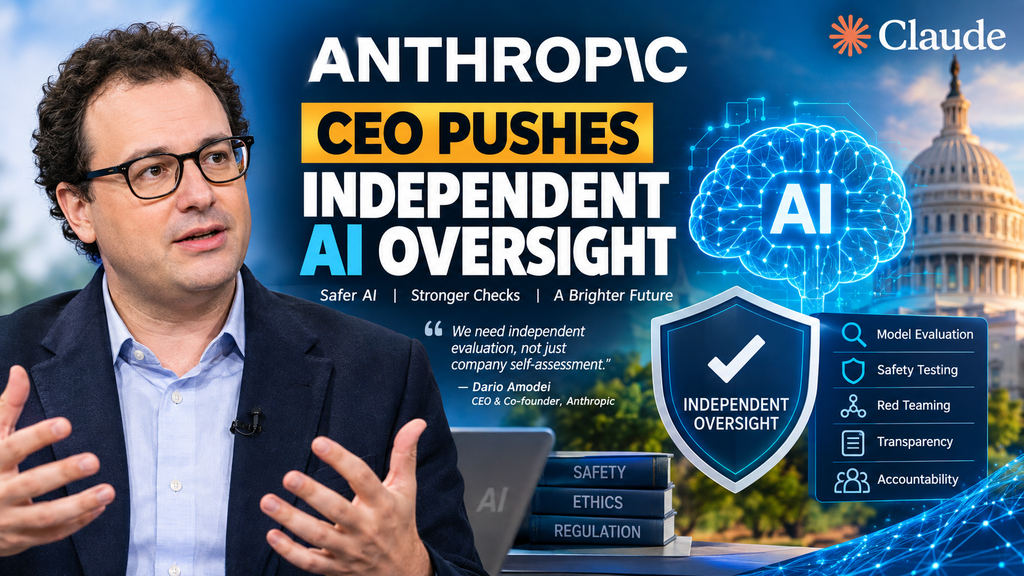
The latest development comes after Anthropic and Accenture announced a joint commitment of at least $2 billion over five years to independently evaluate frontier AI models. The initiative is designed to expand testing, red-teaming and safety assessments of increasingly capable AI systems.
Amodei has also called for the AI industry to slow the pace of frontier-model development, arguing that additional time is needed for safety systems, evaluations and governance mechanisms to catch up with rapidly advancing capabilities. His proposals have triggered a wider debate among technology executives, researchers and policymakers about how advanced AI should be monitored.
🔴 Latest Update: Anthropic Announces $2 Billion AI Evaluation Commitment
One of the biggest developments this week is Anthropic’s partnership with Accenture.
Under the agreement, Accenture’s AI organization, Faculty, will play a leading role in evaluating Anthropic’s advanced models. The work is expected to include:
- Independent model evaluations
- Red-team testing
- AI safety assessments
- Safety-alignment evaluations
- Monitoring potentially dangerous capabilities
- Research into unexpected or uncontrolled AI behavior
Reuters reported that the companies plan to invest at least $2 billion over five years in these evaluation capabilities.
The announcement gives practical form to Amodei’s broader argument that AI companies should not be the only entities evaluating the risks of their own systems.
What Is Dario Amodei Calling For?
Amodei has argued that frontier AI development is advancing quickly enough that safety work could struggle to keep up.
His recent proposal centers on a concept sometimes described as “embedded evaluation.”
Under this approach, independent evaluators would work inside AI companies while maintaining sufficient independence to investigate systems and identify risks.
The objective is to give outside evaluators access to information that may be difficult to obtain through conventional external audits while maintaining a degree of independence from the companies developing the models.
Recent reporting describes Amodei’s broader position as a call for more transparency, independent scrutiny and a slower pace of frontier-AI development.
Why Independent AI Oversight Is Becoming a Major Issue
Modern frontier AI systems are increasingly capable of performing complex tasks, writing and debugging software, interacting with external tools and operating with greater autonomy.
That has created a new challenge for AI safety researchers: how do you reliably evaluate a system when its capabilities are changing rapidly?
Independent evaluators could potentially provide another layer of scrutiny between AI developers and the public.
Supporters of the approach argue that independent evaluation can help identify risks that internal teams might miss.
The idea has also received support from prominent AI researchers and technology leaders. A coalition of AI evaluation organizations has recently called for third-party evaluators to have meaningful access to systems and data, scientific independence and protection from retaliation.
Anthropic CEO Wants AI Development To Slow Down
Amodei’s latest position goes beyond conventional AI safety testing.
He has called for the industry to pace frontier AI development, arguing that progress should continue but that the rate of capability improvements needs to leave sufficient time for safety measures to catch up.
The proposal has attracted attention because Amodei is simultaneously leading one of the companies at the forefront of AI development.
The Washington Post reported that Amodei’s call for a slowdown has received public support from other prominent technology leaders, including OpenAI CEO Sam Altman and Elon Musk.
The Guardian similarly reported that several AI leaders have recently discussed slowing development amid concerns about the potential risks of increasingly powerful systems.
Why AI Companies Are Talking About “Pacing”
The debate is no longer simply about whether AI should be developed.
Instead, the central question increasingly involves how quickly frontier capabilities should advance relative to safety research.
Amodei’s argument can broadly be understood through three connected ideas:
1. Continue AI development
Amodei has not called for abandoning artificial intelligence. Anthropic continues to develop and deploy AI systems.
2. Increase safety evaluation
AI models should undergo increasingly sophisticated testing as their capabilities grow.
3. Give safety work time to catch up
If capabilities advance faster than researchers can understand and control them, new risks could emerge before adequate safeguards are available.
This is the central reasoning behind his call for pacing frontier development.
What Does “Independent Oversight” Actually Mean?
Independent AI oversight can involve several different mechanisms.
Independent model testing
Outside evaluators can test AI systems for dangerous or unexpected capabilities.
Red teaming
Specialists deliberately attempt to make systems fail or behave in undesirable ways.
Safety evaluations
Researchers measure how models behave under controlled scenarios involving cybersecurity, autonomy, deception and other potentially sensitive capabilities.
Incident reporting
Independent organizations can investigate significant AI incidents and assess what went wrong.
Transparency
Companies can provide more information about model capabilities, evaluation results and safety incidents.
The exact legal and organizational structure of independent AI oversight remains an active subject of debate.
Anthropic and Accenture’s $2 Billion Plan: What We Know
| Development | Latest information |
|---|---|
| Companies involved | Anthropic and Accenture |
| Planned investment | At least $2 billion |
| Time frame | Five years |
| Evaluation partner | Accenture’s Faculty AI organization |
| Main focus | Frontier AI model evaluation |
| Testing | Red teaming and safety assessments |
| Objective | Improve independent evaluation of advanced AI |
| Announcement | September 18, 2026 |
The investment represents one of the largest publicly reported commitments specifically connected to independent frontier-AI evaluation.
AI Industry Debate Intensifies
Amodei’s proposal comes as other major AI companies and technology leaders are also discussing AI safety.
OpenAI has recently published work concerning anomalous model behavior and frontier-model safeguards, while Microsoft CEO Satya Nadella has expressed support for the concept of embedded AI evaluators.
The developments suggest that AI safety discussions are increasingly moving from theoretical research toward operational questions:
Who evaluates powerful AI systems?
What information should evaluators receive?
How independent should they be?
Who has authority to intervene when serious risks are identified?
These questions remain unresolved across the industry.
Global AI Oversight Debate Expands
The discussion is also moving beyond Silicon Valley.
European governments have been debating how to balance AI innovation with safety requirements. Germany, for example, has said that stopping AI development entirely is not considered a viable approach while supporting stronger safety measures and international cooperation.
At the same time, governments and technology companies are increasingly discussing international standards for evaluating advanced AI systems.
This creates a complicated policy environment because AI development is simultaneously a commercial, technological, security and geopolitical issue.
The U.S.-China Question
Another important part of the debate involves competition between the United States and China.
Amodei has argued that AI development cannot be considered independently from geopolitical competition, while also warning about risks associated with increasingly powerful AI systems.
Recent reporting has highlighted the tension between two objectives:
Develop advanced AI quickly enough to maintain technological leadership
versus
Develop safety systems capable of managing increasingly powerful models.
That tension is likely to remain one of the defining issues in AI policy discussions.
Could Independent Evaluators Change AI Safety?
The proposed model could potentially create a new layer of accountability.
Instead of AI companies relying exclusively on their own internal safety teams, outside evaluators could receive meaningful access to models and systems.
However, several practical questions remain.
Independence
How can evaluators remain independent if they are financially supported or hosted by the companies they evaluate?
Access
Will evaluators receive sufficient access to models, training information and internal data to identify serious risks?
Confidentiality
How can sensitive corporate information remain protected while allowing meaningful safety investigations?
Enforcement
What happens if evaluators identify a serious problem?
International standards
Will different countries eventually adopt compatible AI evaluation standards?
These questions are likely to become increasingly important as frontier AI systems become more capable.
What Other AI Leaders Are Saying
The discussion around Amodei’s proposal has produced an unusual degree of agreement among some technology leaders who frequently compete with one another.
Recent reports say Sam Altman and Elon Musk have publicly supported aspects of Amodei’s call for greater restraint or additional safeguards.
However, agreement that AI safety matters does not necessarily mean there is agreement on the exact regulatory model, development timeline or degree of government intervention.
Different companies and governments continue to advocate different approaches.
Why This Matters for Everyday AI Users
The debate may sound like a discussion limited to technology companies, but the consequences could eventually affect ordinary users.
AI systems are increasingly being integrated into:
- Search engines
- Office software
- Coding tools
- Customer service
- Education
- Healthcare
- Financial services
- Cybersecurity
- Scientific research
- Autonomous systems
As AI becomes more capable, independent testing could become an increasingly important part of determining whether systems are safe enough for widespread deployment.
What Happens Next?
The next stage will likely focus on whether independent AI evaluation can move from voluntary industry initiatives toward standardized practices.
Key developments to watch include:
• Anthropic’s independent evaluation program
• Results from future frontier-model safety assessments
• Expansion of third-party AI testing organizations
• New U.S. AI oversight initiatives
• European AI safety and regulatory developments
• International discussions involving the United States, China and Europe
• Further proposals from major AI companies concerning frontier-model development
The effectiveness of these mechanisms will depend on how much access evaluators receive, how independent they are and what happens when serious risks are identified.
Anthropic AI Oversight: Latest Takeaway
Anthropic CEO Dario Amodei’s push for independent AI oversight marks a significant development in the debate over how frontier artificial intelligence should be evaluated.
The company’s latest partnership with Accenture, involving a commitment of at least $2 billion over five years, provides a concrete example of the independent-evaluation model Amodei has been advocating.
At the same time, his call to pace frontier AI development has opened a broader discussion about whether safety research and oversight can keep up with rapidly improving AI capabilities.
For now, the major question is not simply how powerful AI can become, but how effectively society can evaluate and govern increasingly capable systems while allowing useful AI development to continue.
America Newsline will continue tracking Anthropic, Claude, OpenAI and the wider frontier-AI safety debate as new developments emerge.
Last updated: September 19, 2026.