
Texas Air National Guard F-16 Crashes During Training Mission in Michigan
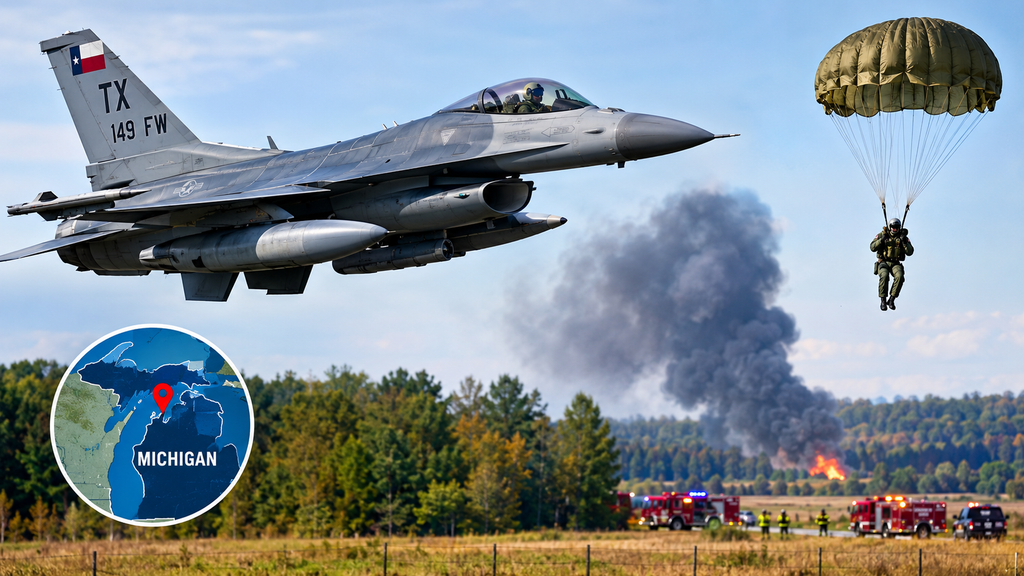
A Texas Air National Guard F-16 Fighting Falcon crashed in northern Michigan on Thursday, September 17, 2026, during a routine training mission, but the pilot successfully ejected from the aircraft and survived the incident.
The aircraft, assigned to the 149th Fighter Wing at Joint Base San Antonio-Lackland in Texas, was conducting training operations from the Alpena Combat Readiness Training Center when the incident occurred near Traverse City in Grand Traverse County, Michigan.
The Texas Military Department confirmed that the pilot successfully ejected and that the crash is under investigation.
What Happened to the F-16 in Michigan?
According to officials and multiple reports, the F-16 was participating in a training exercise when an unspecified incident occurred.
The fighter jet ultimately crashed in the Grand Traverse County area, near County Road 633 and Jefferson Place. Witnesses reported seeing smoke and a fire following the crash.
The pilot ejected from the aircraft before impact. Authorities later said the pilot was receiving medical treatment at a local hospital. Reports indicated the pilot was conscious and able to communicate with law enforcement.
Officials have not publicly released the pilot’s identity.
Was the F-16 Pilot Injured?
The pilot survived the crash after successfully ejecting from the F-16.
The 149th Fighter Wing initially confirmed that the pilot was receiving medical treatment. Subsequent local reporting said the pilot was in stable condition, while officials declined to provide additional medical details.
There were no reported injuries to people on the ground in the initial reports.
Possible Bird Strike Reported, But Cause Has Not Been Confirmed
One important detail remains unresolved: what caused the F-16 to crash?
According to Associated Press reporting, audio from air-traffic-control communications indicated that another pilot reported that the aircraft’s pilot may have encountered a bird strike. However, a representative of the 149th Fighter Wing said he had not heard confirmation of a bird strike and emphasized that the crash remains under investigation.
Therefore, a bird strike should not be described as the confirmed cause of the crash at this stage.
Investigators are expected to examine the aircraft, flight data, communications and other evidence to determine what happened.
Michigan Authorities Ordered a Temporary Evacuation
The crash also prompted an emergency response because of potential hazardous materials at the crash site.
Michigan authorities initially issued a shelter-in-place order for people near the crash location. Residents within approximately one mile of the crash site were subsequently ordered to evacuate because of a hazardous chemical spill associated with the wreckage.
The evacuation order was later lifted, allowing many residents to return home.
One reason emergency crews take particular precautions around crashed military aircraft is that F-16s use hydrazine in their emergency power units. Hydrazine is hazardous and requires specialized handling following an aircraft accident.
Texas Air National Guard Was Conducting Training in Michigan
The crashed aircraft was part of the Texas Air National Guard’s 149th Fighter Wing, which was participating in training activities at the Alpena Combat Readiness Training Center.
The unit’s Michigan training was associated with Operation Northern Cactus, an exercise designed to test the wing’s ability to deploy personnel and equipment and operate away from its normal base in an austere environment.
The F-16 involved in the accident was based at Joint Base San Antonio-Lackland, Texas.
Investigation Underway
Military officials have not yet announced a definitive cause for the crash.
The Texas Military Department said the incident is under investigation and that additional information would be released as it becomes available.
As investigators work to determine what happened, officials are expected to examine the aircraft and circumstances surrounding the training flight.
F-16 Michigan Crash: What We Know So Far
| Detail | Information |
|---|---|
| Aircraft | F-16 Fighting Falcon |
| Operator | Texas Air National Guard |
| Unit | 149th Fighter Wing |
| Home Base | Joint Base San Antonio-Lackland, Texas |
| Location | Grand Traverse County, Michigan |
| Mission | Routine training mission |
| Pilot | Successfully ejected |
| Pilot condition | Reported stable / receiving medical treatment |
| Ground injuries | None reported in initial reports |
| Possible cause | Not confirmed; possible bird strike reported in ATC audio |
| Investigation | Ongoing |
| Emergency response | Temporary shelter-in-place and evacuation orders |
Why This F-16 Crash Matters
The F-16 Fighting Falcon is one of the most widely used fighter aircraft in the U.S. military and has been operated by the U.S. Air Force since the late 1970s.
The Michigan incident highlights the risks associated with military flight training, particularly when fighter aircraft conduct low-level or operational training away from their home installations.
For the Texas Air National Guard, the Michigan exercise was intended to provide realistic training in an unfamiliar operating environment.
The successful ejection also demonstrates the importance of the F-16’s emergency systems and pilot ejection capability in a serious in-flight emergency.
Latest Update on the Michigan F-16 Crash
The most important development is that the pilot successfully ejected and survived, while authorities continue investigating the aircraft crash.
Emergency officials also lifted the broader evacuation order after responding to the hazards at the crash site.
America Newsline will continue to update this story as military officials release verified information about the investigation, the pilot’s condition and the cause of the crash.
FAQ: Texas Air National Guard F-16 Crash
Did an F-16 crash in Michigan?
Yes. A Texas Air National Guard F-16 crashed in Grand Traverse County, Michigan, on September 17, 2026, during a routine training mission.
Did the F-16 pilot survive?
Yes. The pilot successfully ejected from the aircraft before the crash and was taken to a local hospital for medical treatment.
What caused the F-16 crash?
The official cause has not yet been determined. A possible bird strike was mentioned in air-traffic-control communications, but military officials have not confirmed that it caused the crash.
Where did the F-16 crash?
The aircraft crashed in Grand Traverse County in northern Michigan, near the Traverse City area.
Were people on the ground injured?
Initial reports indicated that no other injuries were reported.
Why were residents evacuated?
Authorities ordered a temporary evacuation after reporting a hazardous chemical spill connected to the crash site. F-16 aircraft contain hazardous materials, including hydrazine associated with the emergency power unit.
Which military unit operated the F-16?
The aircraft was assigned to the 149th Fighter Wing of the Texas Air National Guard, based at Joint Base San Antonio-Lackland.