
Published: September 20, 2026
Updated: September 20, 2026
Category: Politics
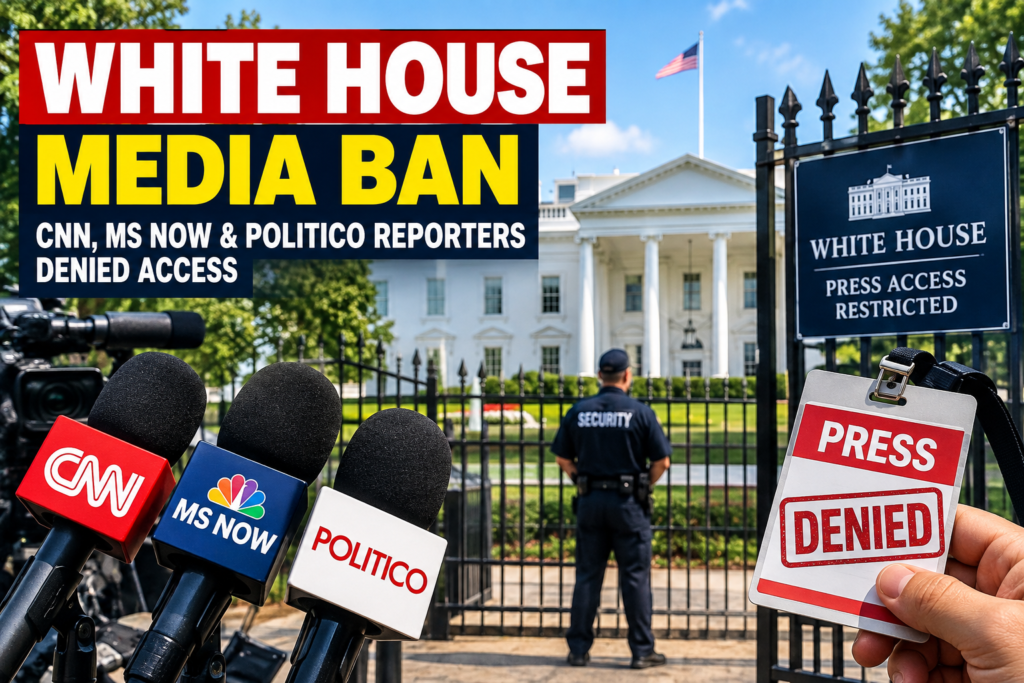
White House Media Ban Latest Update
The White House has enforced President Donald Trump’s announced ban on CNN, MS NOW and Politico, preventing journalists from those organizations from accessing the White House grounds.
The move became operational on Saturday, September 19, after Trump announced the previous day that the three media organizations would be barred because of what he described as “fake news” reporting. Reporters from the affected organizations subsequently reported that their White House press credentials had been disabled or confiscated. [1]
The development has quickly become a major dispute over White House press access, the First Amendment and the relationship between the U.S. government and independent news organizations.
What Happened at the White House?
CNN senior White House reporter Betsy Klein, MS NOW correspondent Akayla Gardner and Politico White House reporter Cheyenne Haslett were among journalists who were denied entry on Saturday.
According to reports, journalists discovered that their press credentials had been deactivated when they attempted to enter the White House. In at least some cases, the physical credentials were confiscated.
MS NOW reported that one of its producers was able to enter while a photographer’s credential was also disabled.
The White House action followed Trump’s September 18 announcement that CNN, MS NOW and Politico would no longer be allowed access to the White House. [1][2]
Why Did Trump Ban CNN, MS NOW and Politico?
Trump said the organizations were being barred because of what he characterized as repeated “fake news” reporting.
In his announcement, Trump accused the outlets of reporting what he described as “fiction and lies” while covering his administration and the United States.
The president did not provide specific examples in the announcement establishing that the three organizations had fabricated particular stories as the basis for the ban. [1][3]
The White House media dispute therefore centers partly on the administration’s characterization of coverage and the government’s authority to determine which journalists receive access to presidential facilities.
Trump Signals More Media Bans Could Follow
The dispute could extend beyond the three organizations already affected.
Trump said that other media organizations could potentially face similar restrictions. During comments at the White House, he mentioned The New York Times and The Washington Post when discussing outlets he considers to have produced “fake news,” although he did not announce that those newspapers had been banned at that time.
Both newspapers subsequently criticized the move and defended the principle of press access. [1]
That means the immediate ban currently concerns CNN, MS NOW and Politico, while the possibility of additional restrictions remains a developing part of the story.
How Have CNN, MS NOW and Politico Responded?
The affected organizations have indicated that they intend to continue covering the Trump administration.
CNN characterized the action as an attack on its constitutional rights and said it would continue its White House reporting.
MS NOW said it would take steps to defend its First Amendment rights.
Politico also said it stood behind its journalists covering the White House. [1][2]
The organizations’ responses indicate that the dispute could move beyond a political confrontation and into the courts.
Could the White House Media Ban Face a Legal Challenge?
The press organizations have indicated that legal action is possible.
The central constitutional issue involves the First Amendment, which protects freedom of speech and freedom of the press.
However, the legal question is more complicated than simply whether journalists have unrestricted access to the White House. Presidential press access involves security, accreditation and operational rules, while government decisions affecting journalists can also raise constitutional questions when access is restricted because of the content or viewpoint of their reporting.
The exact legal outcome will depend on the policies used to impose the restrictions, the government’s stated justification, and how courts interpret the First Amendment in the specific circumstances.
Previous Trump Administration Disputes With Journalists
The latest White House confrontation follows earlier disputes between the Trump administration and news organizations.
During Trump’s first administration, the White House attempted to restrict or suspend press credentials involving journalists including CNN’s Jim Acosta and Playboy correspondent Brian Karem. Federal judges subsequently ordered restoration of press access in those cases. [1]
More recently, the Associated Press faced restrictions after a dispute involving the Trump administration’s preferred terminology for the Gulf of Mexico. The AP challenged the government’s restrictions in court. [1]
These earlier conflicts are now part of the broader background surrounding the latest White House media-access dispute.
White House Media Ban vs. Pentagon Press Restrictions
The White House dispute is also occurring during a broader period of litigation and policy changes involving access for journalists at federal institutions.
At the Pentagon, the Department of Defense introduced revised media-access rules that included requirements for journalists to be escorted during certain visits. A federal appeals panel later reinstated the escort requirement while litigation continues. [4]
The Pentagon situation is legally and factually separate from the White House’s decision involving CNN, MS NOW and Politico, but both developments have contributed to an ongoing national debate over government access for journalists.
What Does the First Amendment Say About the Press?
The First Amendment states that Congress may not make laws abridging freedom of speech or of the press.
That protection does not automatically mean every journalist has unrestricted physical access to every government facility. Government buildings can have security procedures, accreditation requirements and controlled-access areas.
The legal question in a dispute such as this is therefore not simply whether the government can control access to a building. Courts may also consider whether government action unlawfully discriminates against journalists because of their reporting or viewpoint.
Any lawsuit arising from the current White House ban could help clarify how those principles apply to presidential press access.
What Happens Next?
Several developments could determine where the dispute goes from here:
1. Possible Legal Action
CNN, MS NOW or Politico could challenge the restrictions in federal court.
2. Additional Media Restrictions
Trump has suggested that other media organizations could face similar treatment, although no broader ban was confirmed in the latest reports.
3. White House Press Access Rules
The administration could provide additional details about the criteria being used to determine which organizations receive White House access.
4. Court Decisions
If lawsuits are filed, federal judges could be asked to determine whether the restrictions violate constitutional protections or fall within the government’s authority over White House access.
5. Continued Coverage From Outside the White House
The affected organizations have indicated that they will continue reporting on the administration even while their journalists face restricted physical access to the White House.
Why This Story Matters
The White House media ban is not simply a dispute involving three news organizations.
It raises broader questions about how presidential administrations interact with the press, how journalists receive access to government officials, and where the constitutional limits of government control over press access are drawn.
At the same time, the administration argues that it should not be required to provide access to outlets it believes publish inaccurate reporting.
The competing positions are likely to be tested through further political, legal and institutional developments.
Latest White House Media Ban: Key Facts
| Issue | Latest development |
|---|---|
| Media organizations affected | CNN, MS NOW and Politico |
| Announcement | September 18, 2026 |
| Enforcement | September 19, 2026 |
| Reason given by Trump | Reporting he characterized as “fake news” |
| Reporters denied access | Reporters from all three organizations |
| Press credentials | Reported disabled/confiscated |
| Possible legal challenge | Organizations have indicated they may defend their First Amendment rights |
| Other outlets | Trump suggested additional organizations could potentially face restrictions |
| The New York Times & Washington Post | Criticized the move; no ban was announced against them in the latest reports |
Frequently Asked Questions
Is CNN banned from the White House?
CNN journalists were denied access to the White House on September 19 after President Trump announced that CNN would be barred from the White House.
Is MS NOW banned from the White House?
Yes. MS NOW journalists were among those denied White House access after the September 18 announcement.
Is Politico banned from the White House?
Politico’s White House reporter was also denied access after the administration’s announced restriction took effect.
Why were the media organizations banned?
President Trump said the organizations were being barred because of what he characterized as “fake news” reporting about his administration.
Could The New York Times and Washington Post be banned?
Trump mentioned both organizations when discussing media outlets he considers to be “fake news,” but the latest reports do not show that he had formally banned either organization from the White House.
Is the White House media ban being challenged in court?
The affected organizations have indicated that they may pursue legal action based on First Amendment protections. Any formal court challenge and subsequent rulings remain developing.
Does the First Amendment guarantee White House access to every journalist?
Not necessarily. Government facilities can impose security and accreditation rules. The constitutional question can become more complicated when access restrictions are allegedly connected to the content or viewpoint of a journalist’s reporting.
Bottom Line
The White House’s decision to block CNN, MS NOW and Politico journalists represent