
Updated: September 18, 2026
The 2026 United States midterm elections have entered a crucial stage as early voting begins in parts of the country and candidates, political parties and campaign organizations intensify their efforts ahead of Election Day.
The general election is scheduled for Tuesday, November 3, 2026, when Americans will vote for members of Congress along with governors and numerous state and local offices. All 435 seats in the U.S. House of Representatives are scheduled to be contested, while 33 regular U.S. Senate seats are up for election, alongside special Senate contests.
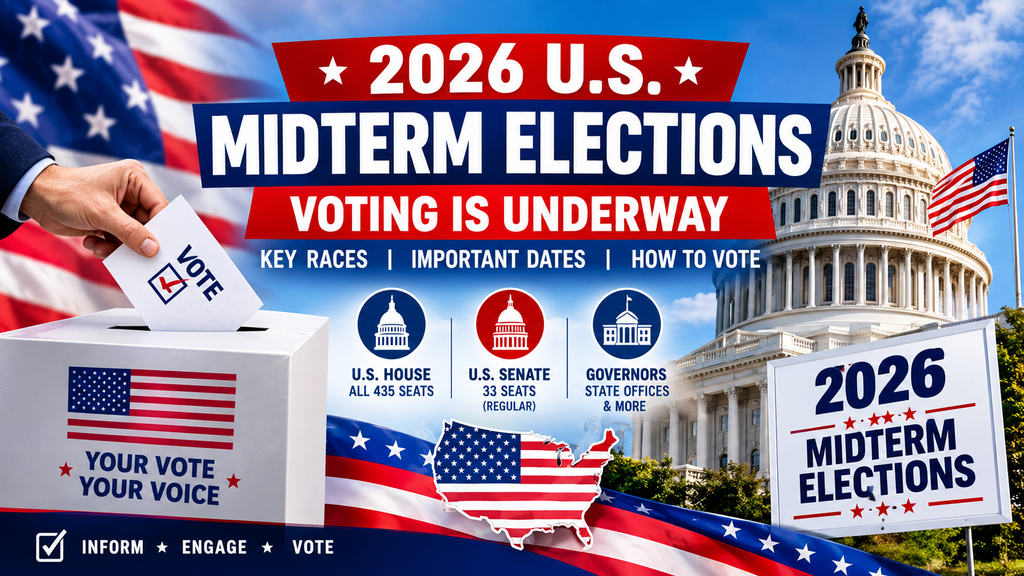
🔴 BREAKING: Early Voting Has Begun
One of the biggest developments on September 18 is the beginning of in-person early voting in Virginia.
Voters in several other states are also beginning to use absentee or early-voting options. The Associated Press reported that voters in states including Idaho, Minnesota and South Dakota can cast absentee ballots in person.
Virginia’s early-voting period is scheduled to continue through October 31, with Election Day falling on November 3.
This means the 2026 midterm election is no longer simply a November event: voting is already underway in some states.
What Are the 2026 Midterm Elections?
U.S. midterm elections take place halfway through a president’s four-year term.
Unlike presidential elections, voters will not choose a president in November 2026. Instead, the election will determine congressional representation and numerous state and local offices.
Major offices being contested include:
- 435 U.S. House seats
- U.S. Senate seats
- State governors
- State legislators
- State constitutional amendments
- Local offices and ballot measures
The exact contests appearing on an individual’s ballot depend on their state, congressional district and local jurisdiction.
Why the 2026 Midterms Matter
The most consequential question nationally is which party will control the House and Senate after the election.
Congress has major responsibilities involving:
- Federal legislation
- Government spending
- Taxes
- Immigration
- National security
- Foreign policy
- Health care
- Infrastructure
- Oversight of the executive branch
- Confirmation of federal officials and judges
The election therefore has consequences beyond individual congressional races.
However, the final balance of power cannot be known until voters cast their ballots and election officials certify the results.
The Issues Driving the 2026 Campaign
Campaign messaging is increasingly focused on several major national issues.
Cost of Living and the Economy
Prices, housing costs, gasoline, wages, interest rates and household affordability have become major campaign topics.
Both parties are attempting to connect economic conditions to their competing policy agendas, while voters are weighing how national economic policies affect their household finances.
Recent national coverage has identified the cost of living as one of the central themes entering the final weeks of the campaign.
Immigration
Immigration and border policy remain major issues in congressional and gubernatorial campaigns.
Candidates are debating border enforcement, deportation policy, legal immigration and the federal government’s role in immigration enforcement.
Election Administration and Voting Rules
Voting procedures have also become an important election issue.
The Trump administration’s attempts to alter federal rules surrounding mail voting have faced legal challenges. Recent court proceedings have blocked implementation of certain proposed restrictions, with litigation continuing around the administration’s authority and the role of states in administering elections.
Because election administration is largely conducted at the state and local level, voters should check their own state’s election authority for the rules that apply to them.
Foreign Policy and the Iran War
The ongoing war involving Iran is another major issue appearing in national political coverage as voters evaluate candidates and the administration’s foreign-policy decisions.
The issue could affect debates involving military spending, U.S. involvement overseas, energy prices and national security.
Artificial Intelligence and Technology
AI regulation and the rapid expansion of data centers have also entered several state-level political debates.
Questions include:
- How should AI companies be regulated?
- How much transparency should AI developers provide?
- Who should oversee powerful AI systems?
- How much electricity and water should data centers consume?
- How should communities handle large-scale data-center construction?
Recent campaigns and governors in several states have begun addressing these issues publicly.
Key Race to Watch: Ohio Senate Election
One of the most closely watched congressional contests is the Ohio U.S. Senate special election.
The race features Republican Jon Husted and Democrat Sherrod Brown, among other candidates.
The contest has attracted substantial outside spending and national attention. Reuters reported on September 18 that Trump-linked and other Republican-aligned political organizations had launched a $14 million advertising effort supporting Husted. Reuters also reported significant fundraising and advertising activity surrounding the contest.
Ohio’s Senate race is particularly important because the Senate’s eventual balance will depend on multiple competitive contests rather than any single race.
Important: Polls and campaign spending are snapshots, not election results. They should not be treated as guarantees of who will win.
Virginia: Early Voting Begins
Virginia is now one of the most closely watched states as voters begin casting ballots.
Early voting began September 18 and is scheduled to continue until October 31. The general election is November 3.
Virginia voters will decide congressional contests as well as several proposed constitutional amendments.
According to recent election coverage, the proposed amendments concern:
- Reproductive-health rights
- Marriage equality
- Restoration of voting rights after completion of a felony sentence
The state’s congressional contests are also attracting national attention.
Virginia Senate Race
Democratic Sen. Mark Warner is seeking another term and faces Republican nominee Bert Mizusawa.
The race is part of a broader set of congressional contests that national political organizations are monitoring closely.
Voters should consult Virginia’s official election authorities for the latest ballot, polling-place and early-voting information.
Texas Is Also Drawing National Attention
Texas is attracting increased attention ahead of November, particularly because of its Senate contest.
Recent Texas Tribune reporting has highlighted Democratic candidate James Talarico’s competitiveness against Republican Ken Paxton in polling, describing the race as unusual in the context of recent Texas political history.
Polling can change significantly before Election Day, and individual surveys have methodological limitations. Readers should therefore look at the dates, sample populations and methodology of individual polls rather than treating one survey as a final prediction.
How Much Money Is Being Spent?
Campaign fundraising and outside spending have reached enormous levels.
USAFacts reported that, as of August 2026, Senate and House candidates had raised approximately $2.67 billion for federal races connected to the November midterms.
The actual financial footprint of the election is considerably broader when political action committees, party committees and other outside groups are included.
Ohio illustrates the scale of the spending battle, with hundreds of millions of dollars in advertising activity reported around the Senate contest.
2026 Midterm Election: Important Dates
| Event | Date |
|---|---|
| Early voting begins in Virginia | September 18, 2026 |
| Virginia early voting continues through | October 31, 2026 |
| U.S. General Election | November 3, 2026 |
| Congressional elections | November 3, 2026 |
Election dates and voting deadlines vary by state.
There is no single nationwide voter-registration deadline. Each state establishes its own deadline and procedures.
How to Register to Vote in the 2026 Midterms
Eligible voters can begin the registration process through the U.S. government’s official voting information service.
Official U.S. voter registration information — Vote.gov/USAGov
Voters should check their state’s requirements because registration deadlines, identification requirements and voting methods vary.
The federal government states that voters can use Vote.gov to select their state or territory and obtain instructions for registering online, by mail or in person, depending on local rules.
Can You Vote by Mail?
Yes, but the rules differ from state to state.
Some states allow voters to request absentee ballots without providing a specific reason, while others have different eligibility requirements.
U.S. citizens living abroad and military voters also have specific absentee-voting procedures.
Official U.S. absentee and mail-voting information
The federal government advises voters to check the requirements and deadlines applicable to their state.
Can Americans Vote Online?
No.
Federal elections in the United States do not offer online voting. Voters generally cast ballots either in person or through an authorized absentee/mail-voting process.
How to Find Your Polling Place
Your polling location depends on where you live.
Voters should verify their polling place before Election Day because locations can change.
Find your official polling place — USAGov
USAGov also provides information about accessibility and voting options.
What Readers Should Watch Between Now and Election Day
The final weeks of the 2026 campaign are likely to focus heavily on:
🗳️ 1. Early-voting turnout
More Americans are beginning to vote before November 3 in states offering early voting.
💰 2. Campaign spending
National political organizations are increasing advertising and field operations in closely contested races.
📊 3. Polling
New surveys will provide snapshots of voter preferences, but methodology and timing matter.
🏛️ 4. Congressional control
The final House and Senate composition will determine the legislative environment for the remainder of the presidential term.
⚖️ 5. Election litigation
Court decisions concerning election rules, ballot access and voting procedures could affect how some voters cast their ballots.
📰 6. State-level races
Governors, legislatures and ballot initiatives could produce major policy changes even outside Washington.
2026 Midterm Elections: Frequently Asked Questions
When are the 2026 U.S. midterm elections?
The nationwide general Election Day is Tuesday, November 3, 2026.
How many House seats are being contested?
All 435 U.S. House districts are scheduled for election.
How many Senate seats are up?
There are 33 regular Senate seats scheduled for election in 2026, with additional special Senate contests occurring during the cycle.
Has early voting started?
Yes. Virginia began in-person early voting on September 18, 2026, while some other states have already begun absentee or related early-voting processes.
Can I vote if I am not registered?
Registration requirements depend on your state. Check the official state deadline before attempting to vote.
Where can I check my voting information?
The official USAGov voting portal provides information about registration, voting methods, polling places and deadlines.
USAGov — How, When and Where to Vote
Bottom Line: The 2026 Midterms Are Entering the Voting Phase
The 2026 U.S. midterm elections have moved into an important new phase, with early voting beginning in Virginia and absentee voting underway in several other states.
The November 3 election will determine the composition of the U.S. House and a significant portion of the Senate, while voters across the country will also decide governors, state legislators, constitutional amendments and local races.
The campaign is increasingly centered on the economy and cost of living, immigration, voting rules, foreign policy, national security and emerging technology issues.
With voting already beginning in some states, voters should check their state-specific registration deadlines, ballot rules and polling information rather than relying on nationwide assumptions.
America Newsline will continue tracking major developments, candidate announcements, polling releases, court decisions, voting deadlines and Election Day results as the 2026 midterm campaign progresses.
This article was updated September 18, 2026. Election rules, candidate fields, court decisions and campaign developments can change. Readers should verify voting information with their state or local election authority before casting a ballot.