
America Newsline | World News Desk | September 18, 2026
The United States–Iran conflict remains one of the world’s biggest developing stories, with military tensions, diplomatic efforts, sanctions and disruption around the Strait of Hormuz continuing to shape events across the Middle East.
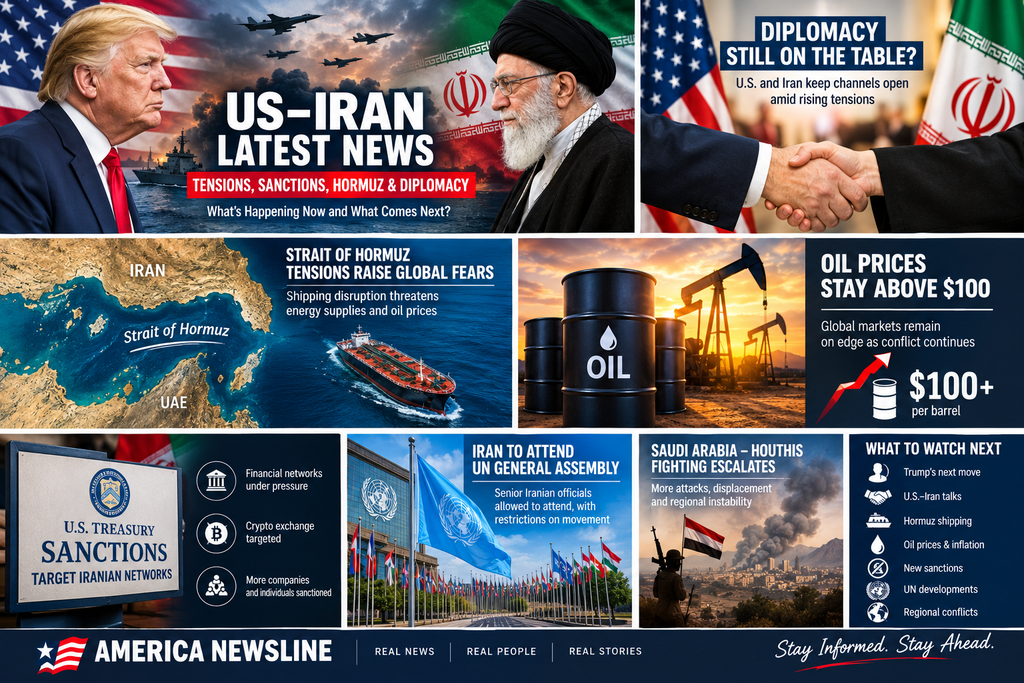
The latest developments come as U.S. President Donald Trump considers his next steps toward Iran, while diplomatic channels remain active but uncertain. At the same time, the United States has expanded financial pressure on Iranian networks, Iran’s leadership is preparing to attend the upcoming United Nations General Assembly in New York, and fighting involving Iran-backed Houthi forces and Saudi Arabia has added another layer to the regional crisis.
Trump said Thursday that he was considering whether to launch further major military action against Iran, while also indicating that he believes a deal remains possible. Reuters reported that Trump said he hoped the conflict was approaching an end, although the situation on the ground and around the Gulf remains unsettled.
For readers trying to understand what is happening now, here is the latest picture.
🔴 US–IRAN LATEST: WHAT IS HAPPENING RIGHT NOW?
The current crisis has several interconnected fronts:
- 🇺🇸 U.S. military operations against Iran
- 🇮🇷 Iranian retaliation and threats
- 🚢 Strait of Hormuz shipping disruption
- 💰 New U.S. sanctions
- 🕊️ Attempts to revive diplomacy
- 🇺🇳 Iran’s planned participation at the UN General Assembly
- 🇸🇦 Saudi Arabia–Houthi fighting
- 🛢️ Oil and energy-market pressure
- 🌍 Growing international diplomatic involvement
The situation remains fluid, and developments can change rapidly.
⚔️ Trump Considers His Next Move
One of the most significant developments is President Trump’s latest comments about the possibility of further military action.
Reuters reported that Trump said he was considering whether to significantly escalate U.S. military action against Iran. At the same time, he has indicated that he believes Tehran wants a deal but has not accepted the terms Washington is seeking.
This creates a complicated picture.
The United States is maintaining military pressure while diplomatic possibilities have not completely disappeared.
Trump has also said he hopes the conflict is nearing an end, according to Reuters.
For now, however, there is no confirmed comprehensive peace agreement ending the conflict.
🕊️ Are the United States and Iran Talking?
Diplomacy remains one of the most closely watched aspects of the crisis.
Recent reporting indicates that Washington and Tehran have continued to signal interest in some form of negotiations, although major disagreements remain.
The earlier diplomatic framework has faced serious setbacks, while questions surrounding Iran’s nuclear program, sanctions relief, the Strait of Hormuz and regional armed groups remain unresolved.
China has also become increasingly involved diplomatically.
Reuters reported that Chinese officials have pressed Iran to help restrain the Houthis following their escalation against Saudi Arabia. Chinese Foreign Minister Wang Yi also discussed the Middle East with U.S. Secretary of State Marco Rubio, calling for restraint and a return to diplomatic consultations.
🚢 Strait of Hormuz: Why the World Is Watching
The Strait of Hormuz is at the center of the crisis because it is one of the world’s most important energy-shipping routes.
Recent attacks and threats have sharply reduced shipping activity.
Reuters reported that vessel crossings through the Strait remained in the single digits, with only four crossings recorded on September 15, down from seven the previous day.
The reduction matters because large volumes of oil and other energy products normally move through the waterway.
Any prolonged disruption can affect:
- Crude oil prices
- Gasoline prices
- Shipping costs
- Insurance premiums
- Asian energy supplies
- Global inflation
- Airline and transportation costs
🛢️ Oil Prices Remain Above $100
The conflict continues to influence global energy markets.
Reuters reported on September 18 that Brent crude was around $103.77 per barrel, while U.S. West Texas Intermediate was around $100.88. Prices fell roughly 1% during the session but remained above $100.
Markets have been watching whether alternative shipping routes can reduce the impact of disruptions around Hormuz.
However, uncertainty remains high.
A prolonged interruption to energy shipments could place additional pressure on consumers and businesses worldwide.
💰 New U.S. Sanctions Target Iranian Financial Network
Washington has also continued its economic campaign against Tehran.
On September 17, the United States imposed sanctions on BitBank, an Iranian cryptocurrency exchange controlled by sanctioned financier Babak Zanjani.
The U.S. Treasury accused the exchange of helping facilitate payments connected to passage through the Strait of Hormuz and supporting Iran’s Islamic Revolutionary Guard Corps.
Additional companies and individuals connected to the network were also sanctioned.
The action is part of the U.S. government’s broader effort to disrupt Iranian sanctions-evasion and financial networks.
Iran’s UN Delegation Gets Permission to Enter the U.S.
In another significant diplomatic development, the Trump administration has decided to allow senior Iranian officials to attend the upcoming United Nations General Assembly in New York.
Reuters reported that Iranian President Masoud Pezeshkian and Foreign Minister Abbas Araqchi will be permitted to attend.
The delegation will face restrictions on movement and other conditions while in the United States.
The decision is notable because it comes while the two countries remain involved in an active military confrontation.
The UN General Assembly therefore provides a potential venue for diplomatic discussions even as tensions remain high.
China’s Role Is Growing
China has emerged as an important diplomatic player.
Reuters reported that Beijing has privately asked Tehran to help rein in Yemen’s Houthis after Saudi Arabia appealed to China for assistance.
China is also maintaining communication with Washington.
Chinese Foreign Minister Wang Yi spoke with U.S. Secretary of State Marco Rubio, with the Middle East among the issues discussed.
China has urged Washington and Tehran to exercise restraint and return to consultations.
Saudi Arabia and the Houthis: A New Regional Front
The conflict is no longer confined to direct U.S.–Iran confrontation.
Saudi Arabia and Yemen’s Iran-aligned Houthis have exchanged attacks.
Reuters reported that Saudi forces conducted strikes in Yemen while Houthi attacks targeted Saudi territory. More than 100,000 Yemenis were reported displaced, with some people crossing the Red Sea toward Djibouti.
The fighting has therefore added a significant humanitarian and regional-security dimension to the broader crisis.
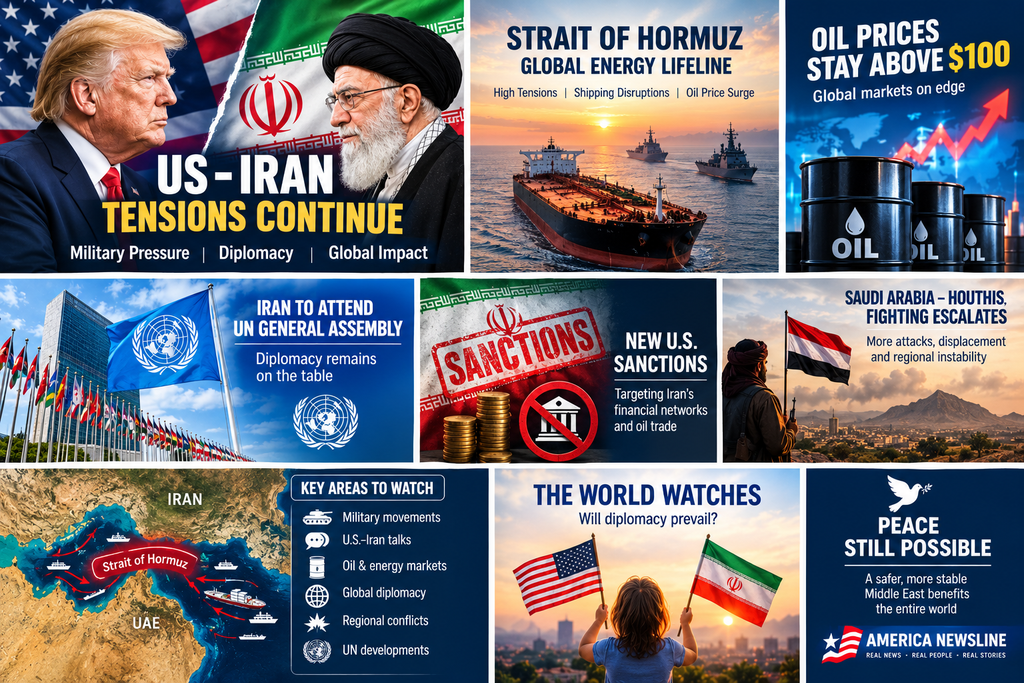
🚨 Strait of Hormuz Tanker Incident
Iran’s Revolutionary Guards have reported an incident involving a Togo-flagged oil tanker in the Strait of Hormuz.
The Guards said the tanker was struck and caught fire.
The incident adds to concerns about commercial shipping safety in one of the world’s most important maritime corridors.
Because commercial shipping has already fallen sharply, additional tanker attacks could further affect energy markets and insurance costs.
What Is the U.S. Trying to Achieve?
The Trump administration has linked its Iran policy to several objectives, including:
Nuclear issue
Washington has sought restrictions on Iran’s nuclear capabilities.
Maritime security
The U.S. wants commercial shipping to operate through the Strait of Hormuz.
Regional security
The administration has also focused on Iran’s relationships with armed groups across the Middle East.
Economic pressure
Sanctions are being used to restrict Iranian financial resources and international transactions.
The precise terms of any future settlement remain under negotiation.
What Does Iran Want?
Iran has continued to emphasize several priorities, including:
- Removal or easing of U.S. sanctions
- Protection of its nuclear rights for peaceful purposes
- Security guarantees
- Restoration of normal shipping through the Gulf
- An end to military attacks
- Recognition of Iranian sovereignty
The two sides remain far apart on several core issues.
☢️ The Nuclear Question
Iran’s nuclear program remains central to the dispute.
The United States and its allies have long expressed concerns about Iran’s ability to develop nuclear weapons.
Iran maintains that its nuclear program is for peaceful purposes and has repeatedly rejected accusations that it seeks nuclear weapons.
The diplomatic challenge is therefore to determine what restrictions, monitoring mechanisms and guarantees could satisfy both sides.
The issue is complicated by the collapse of earlier nuclear diplomacy and the continuing military confrontation.
UN Raises Questions About Conduct During the Conflict
Another major development is a new United Nations investigation.
A UN fact-finding mission said it found reasonable grounds to believe that U.S. military strikes in Iran in February may have violated international humanitarian law, including strikes involving a school and sports facility.
The same UN investigation also reported findings concerning alleged crimes against humanity committed by Iranian authorities during an anti-government crackdown.
Both Washington and Tehran have disputed allegations against them.
These findings remain part of an international accountability process and should not be confused with a criminal conviction.
💵 How Much Is the War Costing the United States?
The economic cost of the conflict is becoming another major U.S. domestic issue.
Reuters reported that the Congressional Budget Office estimated the U.S. conflict-related cost had reached approximately $38 billion, with spending expected to increase further.
The CBO also projected that the conflict could increase U.S. inflation by approximately 0.5 percentage points during the first three months of 2027, according to Reuters.
The financial impact includes military operations, ammunition, logistics and other defense expenditures.
🏛️ Congress and the Iran Conflict
The war has also become a major issue inside Washington.
The U.S. House has voted repeatedly on resolutions concerning presidential war powers.
The latest House vote sought to restrict President Trump’s ability to continue military operations without additional congressional authorization, according to AP.
The debate reflects a broader constitutional question over the balance between presidential military authority and Congress’s power over war.
🌍 Why the Conflict Matters Beyond the Middle East
The U.S.–Iran confrontation has implications far beyond Washington and Tehran.
Energy
Disruption around Hormuz can affect global oil supplies.
Shipping
Commercial vessels face higher security risks and insurance costs.
Inflation
Higher energy and transportation costs can feed into consumer prices.
Aviation
Fuel prices influence airline operating costs.
Financial markets
Investors are watching geopolitical risk and energy prices.
Global diplomacy
China, Russia, European countries and Gulf states are all affected by the conflict.
📊 US–Iran Crisis at a Glance
| Issue | Latest situation |
|---|---|
| Military conflict | Continuing |
| U.S.–Iran diplomacy | Uncertain/intermittent |
| Strait of Hormuz | Severe shipping disruption |
| Oil prices | Above $100 per barrel |
| U.S. sanctions | Expanded |
| Iranian UN delegation | Expected to attend UNGA |
| China | Increasing diplomatic involvement |
| Saudi–Houthi fighting | Continuing |
| Nuclear issue | Unresolved |
| Peace agreement | No comprehensive settlement confirmed |
🔴 LIVE DEVELOPMENTS TO WATCH
For America Newsline’s continuing coverage, these are the developments that could change the story fastest:
1. Any announcement from Trump regarding additional military action
2. Direct U.S.–Iran diplomatic contacts
3. Developments involving the Strait of Hormuz
4. Additional tanker attacks
5. New U.S. sanctions
6. Iranian military responses
7. Saudi-Houthi escalation
8. Statements from China, Russia and Gulf governments
9. Iran’s appearance at the UN General Assembly
10. Changes in global oil prices
❓ What Happens Next?
The immediate future depends on whether military pressure produces another diplomatic opening or whether additional attacks deepen the confrontation.
Three areas will be particularly important:
Diplomacy
Any direct or indirect U.S.–Iran negotiations could change the trajectory of the crisis.
Hormuz
A sustained reopening of the waterway would reduce pressure on energy markets, while further disruption could increase it.
Military decisions
Any new U.S., Iranian or regional military action could rapidly change the situation.
At present, there is no confirmed final peace agreement, and the conflict remains fluid.
🌎 WHAT THIS MEANS FOR AMERICANS
For people in the United States, the most immediate potential effects are economic rather than military.
Higher oil prices can affect:
- Gasoline
- Diesel
- Air travel
- Shipping
- Food transportation
- Manufacturing
- Household expenses
The Congressional Budget Office’s inflation estimate illustrates why economists and policymakers are watching the conflict closely.
📰 AMERICA NEWSLINE FINAL UPDATE
The U.S.–Iran crisis remains active on September 18, 2026, with no comprehensive peace agreement yet confirmed.
America Newsline will continue monitoring military developments, diplomacy, the Strait of Hormuz, oil markets, sanctions and international responses as new information becomes available.
Last updated: September 18, 2026.