
America Newsline | Washington, D.C. | September 18, 2026
A bipartisan congressional push to address the growing electricity demands of America’s data-center and artificial-intelligence boom hit a major roadblock in the Senate Thursday.
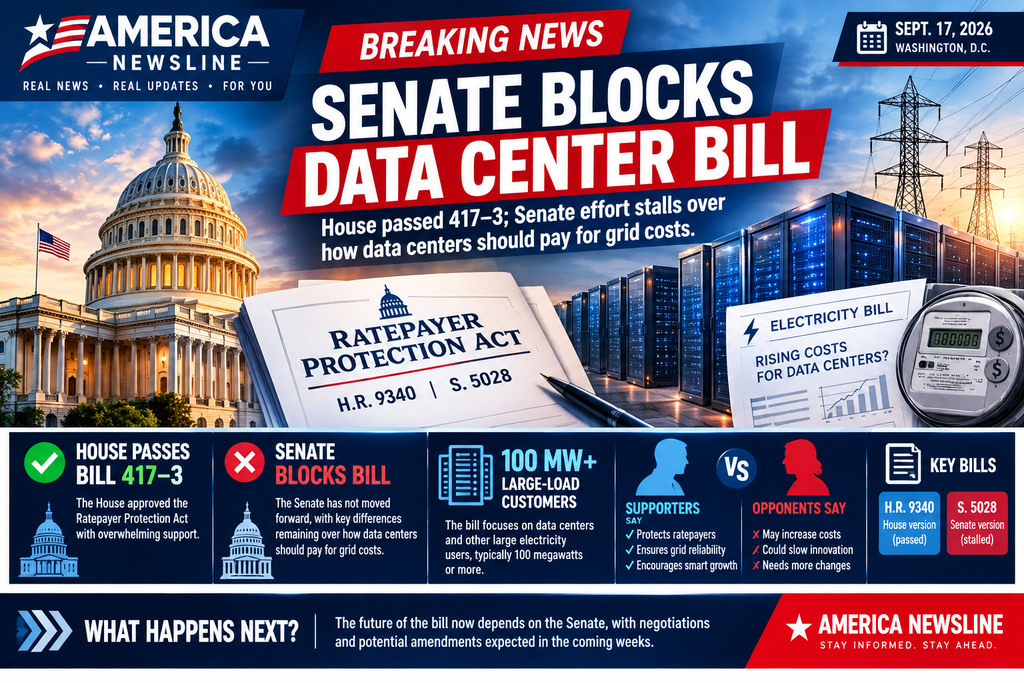
The House of Representatives had passed the Ratepayer Protection Act, H.R. 9340, by an overwhelming 417–3 vote on September 16. But when Ohio Republican Sen. Jon Husted attempted to move the Senate version forward through unanimous consent on September 17, New Mexico Democrat Sen. Martin Heinrich objected.
Heinrich argued that the legislation does not go far enough because it would primarily require states to consider standards under which large data centers would cover the incremental costs associated with serving their electricity demand, rather than imposing a uniform federal requirement.
Heinrich instead sought unanimous consent for his own GRID Savings Act, S. 5199. Ohio Republican Sen. Bernie Moreno objected to that proposal, leaving both measures without the fast-track approval their sponsors sought.
The confrontation has put a major question back at the center of Washington’s debate over artificial intelligence:
Who should pay for the enormous amount of electricity and grid infrastructure required by America’s rapidly expanding data centers?
⚡ WHY THIS STORY MATTERS
Data centers are becoming one of the fastest-growing sources of electricity demand in parts of the United States.
Facilities supporting cloud computing, artificial intelligence, data storage and other digital services can require enormous amounts of electricity. Their construction can also require utilities to expand generation, transmission and distribution infrastructure.
That creates a policy question for regulators and lawmakers:
Should the companies building these facilities pay the full incremental cost of the infrastructure needed to serve them, or can some of those costs be spread among other electricity customers?
The Ratepayer Protection Act is designed to address that question.
🏛️ WHAT HAPPENED IN THE HOUSE?
The House passed H.R. 9340 on September 16, 2026, by a vote of 417–3.
The vote included support from lawmakers in both parties. According to the recorded vote, 210 Republicans voted yes, 206 Democrats voted yes, and one independent voted yes. Three Democrats voted against the measure.
The bill’s sponsor is Rep. Gabe Evans, Republican of Colorado.
The House legislation would amend federal utility law to establish standards concerning recovery of the full incremental costs associated with upgrades needed to serve large-load customers.
The legislation defines the relevant large-load facilities around a 100-megawatt threshold, according to the bill’s congressional summary.
📜 WHAT DOES THE RATEPAYER PROTECTION ACT ACTUALLY DO?
The headline can make the legislation sound more direct than it is.
The bill does not simply impose a nationwide electricity surcharge on data centers or automatically lower household electric bills.
Instead, it establishes a federal framework concerning how utilities and state regulators should address the incremental costs associated with large electricity users.
The central idea is that large-load customers should be responsible for the additional generation, transmission and distribution infrastructure required to serve them.
The House version also contains provisions concerning financial assurances or contributions from large-load customers before certain infrastructure upgrades are made.
In practical terms:
A large data center needs substantially more electricity.
The utility may need additional generation capacity, transmission facilities or distribution upgrades.
Those investments cost money.
The legislation is intended to make sure the costs attributable to serving the large load are appropriately assigned to that customer rather than broadly shifted to other electricity users.
🔴 WHY DID THE SENATE STALL?
This is where the story becomes more complicated.
Sen. Jon Husted, Republican of Ohio, attempted to advance the Senate version, S. 5028, through unanimous consent.
Under unanimous consent, a single senator can prevent the request from going forward simply by objecting.
Sen. Martin Heinrich objected.
Heinrich said he agreed that data centers can create higher electricity costs but argued that Husted’s approach was insufficient because it asks states to consider standards rather than creating what Heinrich described as a stronger mandatory federal requirement.
After blocking Husted’s request, Heinrich attempted to move his own legislation.
That effort was then blocked by Sen. Bernie Moreno.
So Thursday’s Senate action produced two competing objections rather than a final vote on either bill.
🧾 HUSTED’S BILL VS. HEINRICH’S BILL
The two proposals address the same broad problem but use different approaches.
| Issue | Ratepayer Protection Act — S. 5028 | GRID Savings Act — S. 5199 |
|---|---|---|
| Senate sponsor | Jon Husted, R-Ohio | Martin Heinrich, D-N.M. |
| Introduced | July 16, 2026 | July 30, 2026 |
| Main focus | Large-load cost recovery | Federal oversight of large-load interconnections |
| Large-load threshold | 100 MW | 150 MW |
| Regulatory approach | Federal standard for state consideration | Federal Energy Regulatory Commission authority |
| Data-center costs | Addresses incremental infrastructure costs | Requires covered large loads to pay specified interconnection/direct-assignment costs |
| Current status | Senate fast-track attempt blocked | Senate fast-track attempt also blocked |
S. 5028 was introduced July 16 and referred to the Senate Energy and Natural Resources Committee. S. 5199 was introduced July 30 and likewise referred to that committee.
🧑⚖️ WHAT HEINRICH SAYS
Heinrich’s position is that simply encouraging states to consider cost-allocation standards does not provide sufficient protection for electricity customers.
He has argued that large data-center operators should be required to pay for the grid facilities needed to connect and serve their facilities.
His alternative, the GRID Savings Act of 2026, would clarify Federal Energy Regulatory Commission jurisdiction over certain large-load interconnections.
The bill defines a covered large load as a new or expanded nonresidential electric load with projected or requested peak demand of at least 150 megawatts behind a single point of interconnection, subject to the bill’s definitions.
Heinrich also says his proposal would address issues beyond electricity costs, including community engagement, water use and environmental impacts. Those are his stated policy arguments and should be distinguished from the bill’s actual statutory provisions.
🧑⚖️ WHAT HUSTED AND SUPPORTERS SAY
Husted has argued that the Ratepayer Protection Act represents a bipartisan opportunity to prevent households and small businesses from being left with infrastructure costs associated with enormous new electricity loads.
The House’s 417–3 vote gives the legislation substantial evidence of bipartisan support in that chamber.
Husted also said after Thursday’s Senate setback that he intended to continue pushing the issue.
Supporters emphasize that the bill would establish a mechanism for states to consider making large-load customers pay the full incremental cost of infrastructure required to serve them.
🔵 WHY DATA CENTERS NEED SO MUCH POWER
Modern data centers are not simply large office buildings filled with computers.
Large facilities can contain thousands of servers operating around the clock.
Artificial intelligence has added another layer of demand.
AI systems require intensive computing power for both training and inference, and that computing requires electricity.
As technology companies build increasingly large facilities, utilities must determine how to provide sufficient power while maintaining reliability.
That can require:
- New generation capacity
- Transmission upgrades
- Substation improvements
- Distribution infrastructure
- New interconnection facilities
- Additional backup and reliability resources
The policy dispute is therefore not whether data centers use electricity — they clearly do — but how the resulting infrastructure costs should be allocated.
💡 COULD DATA CENTERS RAISE ELECTRICITY BILLS?
This is one of the most important questions being debated.
The answer depends heavily on local electricity markets, utility rate structures, existing generation capacity and how regulators allocate infrastructure costs.
Critics of the current system argue that if utilities spread the cost of new infrastructure across a broad customer base, households and smaller businesses can end up paying some of the costs associated with serving very large industrial loads.
Supporters of the Ratepayer Protection Act say requiring large-load customers to cover their incremental costs can reduce that risk.
Opponents and critics of the House approach argue that simply requiring states to consider such standards may not guarantee that consumers will be protected.
These are competing policy arguments rather than settled nationwide outcomes.
🤖 THE AI CONNECTION
The debate is closely tied to America’s artificial-intelligence expansion.
Major technology companies are building increasingly powerful computing infrastructure, while utilities are preparing for higher electricity demand.
The result is a new intersection between:
AI development + electricity demand + grid investment + consumer rates.
That intersection is quickly becoming a major policy issue for states and Congress.
🏢 DATA CENTERS ARE ALSO AN ECONOMIC DEVELOPMENT ISSUE
The debate isn’t only about electricity bills.
Data centers can bring:
- Construction activity
- Capital investment
- Property-tax revenue
- Technology infrastructure
- New employment during construction
- Long-term technical and operations jobs
Communities considering large facilities therefore face multiple competing considerations.
At the same time, communities can raise concerns about:
- Electricity demand
- Grid capacity
- Water consumption
- Land use
- Noise
- Environmental effects
- Local infrastructure requirements
The congressional debate reflects that broader tension.
⚠️ WHAT THE HOUSE BILL DOES NOT MEAN
Several headlines circulating online can make the legislation sound more sweeping than it is.
It does NOT mean every data center will automatically pay a specific nationwide electricity rate.
It does NOT mean household electricity bills will immediately fall.
It does NOT mean Congress has banned or paused data-center construction.
It does NOT mean the Senate has permanently rejected the proposal.
And Thursday’s Senate action was NOT a recorded vote defeating the bill.
The immediate Senate action was a failure to obtain unanimous consent because senators objected to competing proposals.
📅 WHAT HAPPENS NEXT?
The legislation remains a live congressional issue.
H.R. 9340 has passed the House and moved to the Senate.
But the Senate’s September 17 procedural confrontation demonstrates that there are significant differences over how federal policy should address data-center electricity demand.
The Senate could potentially consider the legislation through the regular legislative process, negotiations could produce amendments, or lawmakers could pursue another legislative vehicle.
At present, neither the Ratepayer Protection Act nor Heinrich’s GRID Savings Act has become law.
The official legislative records show S. 5028 and S. 5199 remain Senate measures, while H.R. 9340 has cleared the House.
🔥 WHY THIS COULD BECOME A BIGGER NATIONAL ISSUE
The debate is arriving as data-center construction accelerates and as electricity demand becomes increasingly important to AI development.
That means the issue extends far beyond one bill.
The broader questions include:
Who pays for new power infrastructure?
How much electricity should large data centers be guaranteed access to?
How should utilities protect existing customers?
Should federal regulators establish nationwide rules?
How much authority should remain with state utility commissions?
How should water and environmental impacts be addressed?
Can the United States expand AI infrastructure without placing disproportionate costs on other electricity users?
Those questions are likely to remain central to the data-center debate.
📊 THE NUMBERS AT A GLANCE
417–3 — House vote approving H.R. 9340.
100 MW — Key large-load threshold in the House Ratepayer Protection Act.
150 MW — Threshold used for a covered large load in Heinrich’s GRID Savings Act.
S. 5028 — Senate Ratepayer Protection Act introduced by Jon Husted.
S. 5199 — GRID Savings Act introduced by Martin Heinrich.
September 16, 2026 — House passes H.R. 9340.
September 17, 2026 — Senate unanimous-consent efforts on the competing approaches fail after objections.
🗣️ WHAT EACH SIDE IS ARGUING
Supporters of H.R. 9340 / S. 5028 emphasize:
- Large electricity users should bear the costs associated with infrastructure needed to serve them.
- Households and small businesses should not be responsible for costs attributable to large data-center loads.
- States should have a framework for addressing those costs.
- The House vote demonstrated broad bipartisan support.
Critics of that approach emphasize:
- State consideration is not the same as a mandatory nationwide requirement.
- Federal legislation could impose stronger and more consistent requirements.
- Data-center interconnection and grid costs need enforceable rules rather than voluntary or optional approaches.
Heinrich’s alternative emphasizes:
- Federal oversight through FERC.
- Mandatory cost responsibility for certain large loads.
- A 150-MW threshold for covered loads.
- Standardized interconnection procedures.
These positions describe the competing legislative approaches; they do not establish which approach will ultimately become law.
THE BIGGER PICTURE
America’s AI race is increasingly becoming an energy and infrastructure story.
The United States wants to expand computing capacity, but every new hyperscale data center requires electricity, transmission capacity and physical infrastructure.
That creates a difficult policy balancing act.
Technology companies want enough power to expand.
Utilities need to maintain reliability.
States want investment and economic development.
And households and businesses want predictable electricity costs.
The Senate’s latest impasse shows that lawmakers broadly recognize the issue but do not yet agree on exactly how federal policy should solve it.
🚨 AMERICA NEWSLINE FINAL UPDATE
The Senate has not passed or formally rejected the Ratepayer Protection Act.
The latest development is that Sen. Martin Heinrich blocked Sen. Jon Husted’s attempt to advance the House-passed approach through unanimous consent. Heinrich then attempted to advance his own GRID Savings Act, which Sen. Bernie Moreno blocked.
The House bill remains significant because it passed 417–3, but additional Senate action is needed before it can become law.
For American electricity customers, the larger question remains unresolved:
As AI data centers consume more power, who should pay for the new infrastructure needed to keep them running?
That debate is now moving from utility commissions and statehouses directly into the center of the U.S. Congress.
America Newsline will continue tracking the Ratepayer Protection Act, the GRID Savings Act, congressional negotiations, data-center construction and developments affecting electricity customers.
Last updated: September 18, 2026